

Last March I posted a blog where I said I’d like fathers to see comforting as more of a core part of their role. That post resulted in some interesting comments. One that jumped out at me was one person’s observation that sometimes when she’s losing it, she does not want to be touched or hugged.
This comment made me reflect on what comforting really means. When you think about it, “the hug” is often used as a proxy for comforting in general. When people express distress on social media, friends often respond with “sending hugs” or simply “hugs. It’s just a handy way of expressing support. But sometimes I wonder if we’ve inadvertently elevated the hug to too lofty a position in the realm of comforting.
Personally, when I’m upset I seldom want a hug right away. I want sympathy but not necessarily verbal expressions of sympathy. What I’d find most helpful, I think, is more a kind of compassionate acceptance – support that doesn’t make me feel worse (more about that in a minute), but instead offers quiet acknowledgement of my situation and perhaps assistance, if there’s a practical the issue at hand. Most importantly, what I need is support that gives my brain/body stress recovery system the space to do its job in helping me feel better.
Unfortunately, I think some of our attempts to comfort people can backfire in the short term because they are experienced almost as pressure to feel better. “There, you’ve gotten your hug, now it’s time to feel better.” That “pressure,” usually unintended, makes me feel worse.
That’s an overly simplistic (and cynical) analysis, but here’s my point.
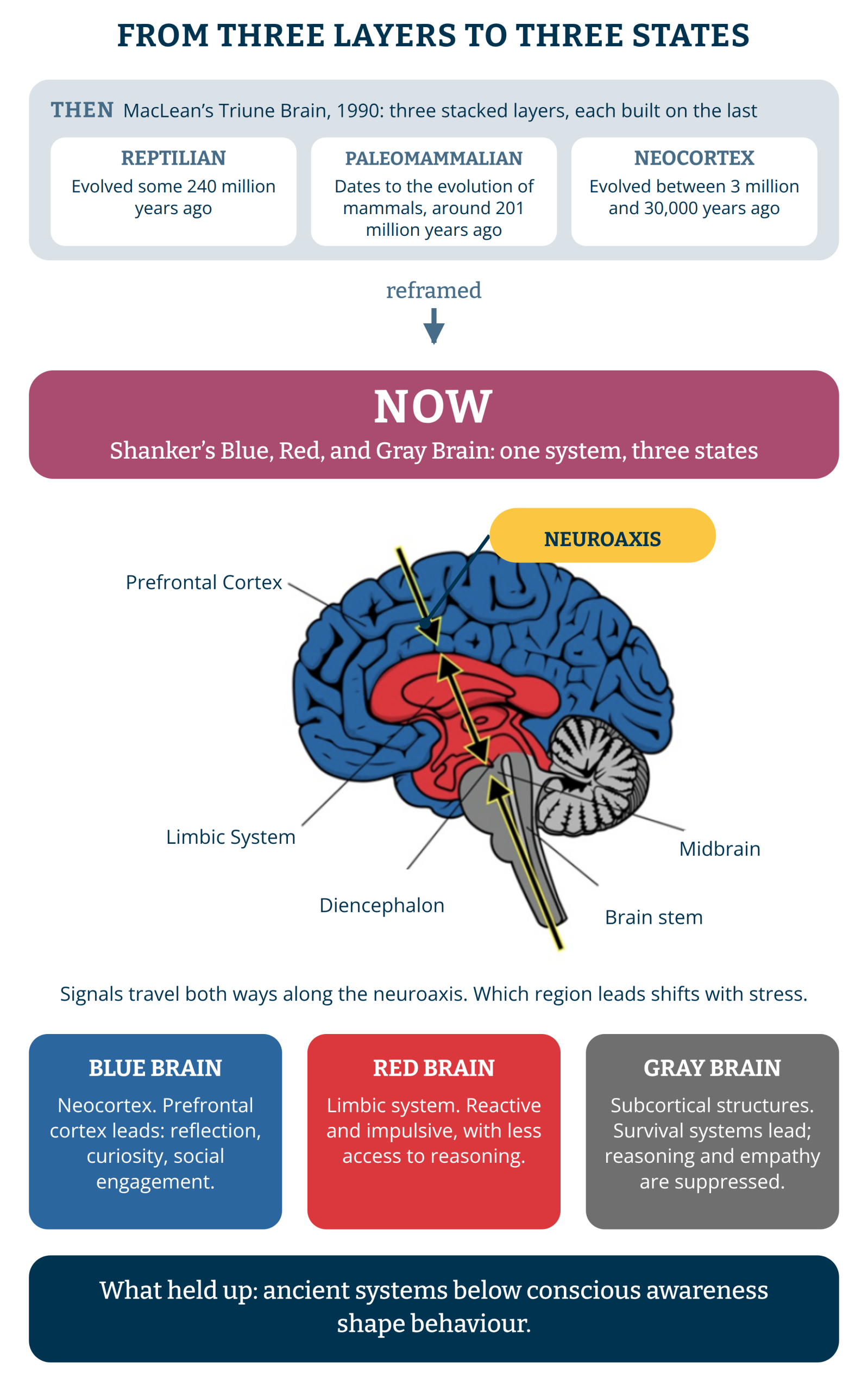
I definitely do not mean to cast aspersions on people’s (including my own) sincere and humanly imperfect attempts to comfort others. But I do think we need to pause and consider how often our attempts to offer comfort have unintended negative effects. It strikes me that sometimes our rush to comfort is as much about relieving our own prosocial stress as it is about helping the other person. I’m not impugning prosocial stress. It’s a key part of what prompts us to offer comfort. But ideally, we’re looking for a kind of blue brain-red brain balance here. The red brain triggers us to offer comfort, while the blue brain helps us stay alert and engaged so we can figure out the best way to do it. That includes attunement to the non-verbal cues the other person is giving us, which might be saying, “Don’t touch me right now!”
So with a child and a father (or mother, but this conversation started with the father’s role) comforting might sometimes mean well-timed distraction followed by a father-child play session. Or it might mean help with a practical problem that is causing the stress. It could also be providing a snack of apples, crackers and cheese (which was a go-to with our kids at times).
Often, the key part of comforting is simply being a calm, quiet, non-judgmental, non-pressuring presence. Comforting can involve words: soothing statements, guidance or advice. But not always, at least not at first.
I recall an encounter with my middle son, about four at the time. His older brother had just driven him into a total meltdown—a sad one rather than an angry one (perhaps ““crumbledown” would be a more apt term). I can’t remember all the things I did to try to comfort him. Some may have been unhelpful. What worked in the end was getting him out of the situation (i.e. away from his brother) and sitting quietly with my arm around him. Eventually I could feel his breathing slow down and the tension start to ease from his body. There were very few words. No explanation designed to help him process the situation on a cognitive level. No attempt to talk him into feeling better. It was his parasympathetic nervous system (PNS) that helped him feel better, although it took about 20 minutes. My role, in hindsight, was to help create the conditions where his PNS could do its good work.
I wonder if that just might be the essence of comforting.
I’ve made a number of points here, and barely scratched the surface. Lots to talk about. How do you see the idea of comfort, beyond hugs?
Explore the Self-Reg science with out Self-Reg certificate programs. Check them out HERE.


24 Comments
I tend to comfort people by letting them know I am there if they to talk or just being there even in silence.
That is great to hear, Tan! How do you find people respond to that? I’d love to hear more.
Aviva
I think it is great when someone says if you need me I will be here for you. There are times when all you do is sit and wait quietly or you may offer a space for just them to calm and regulate themselves.
Debbie, I love how you equated this to “space.” I wonder in what other ways, giving space might be helpful. Thoughts?
Aviva
I think hugs are still a universal way to comfort someone in stress and to be on a safe side I would ask if a person or a student is OK with this. Another way to give a comfort is to talk to the student, sit at the same level , beside or near by and assure him/her that he can look at me any time or hold my hand or use my special friend( stuffy or weighted toy) to feel more comfortable and secure in the stressful situation.
I love the many different ideas that you mentioned here, Tatyana! I wonder if this speaks to the “self” component of Self-Reg. What do you think?
Aviva
Hugs are still the best stress reducer! Comfort beyond hugs to me is about. I’m thinking of the student I’m currently with and it would be about articulating therefore feelings for them and validating them and making them OK.
Thanks for your comment, Loraie! I wonder if all kids and adults feel the same way about hugs. What do you think?
Aviva
I find that by sitting or standing with someone and just holding their hand and letting them know I’m here for them; is what helps. I usually give a hug after, that is when I can feel their calm, and their breathing . The human touch is a wonderful gift when offered in a meaningful way.
Thanks for your comment, Terryrae! I wonder if everyone feels the same way about physical touch. Could it be dysregulating for some? What do you think?
Aviva
Would food be comfort and then become a biological stress on top of that? Joking aside, but my comfort under emotional stress is bannock. I miss home and traditional food helps me when I am far away from home. But under other domains of stress, quiet comfort I think works. When there’s extreme emotional stress, in our cultural, ppl gather, bring food, and everyone is at the person’s home. There’s a calmness lent in like a mass gathering. Everyone brings something, food, water, games, cards, pictures, puzzles. That’s how we lend our calm in small northern communities.
That’s such an interesting point about food, Crystal! I think about this article on over-eating (and obesity). It views food in a slightly different way. What do you think?
https://self-reg.ca/reframing-how-we-look-at-obesity/
Aviva
When I’m stressed, I like to walk. Sometimes when students are upset, I offer them a walk and talk. I find this very effective. I usually walk laps around the outside of the school with the student and let them talk. If they don’t want to talk, then I will tell them something about my cat or my sons that was unusual or funny. This usually helps the student. In our district, we aren’t supposed to hug students, so I never do unless I think it’s really needed, and then I always ask first.
Thanks for sharing, Alice! I love the idea of walking and talking. You make a great point here about asking before hugging. I always do this. I think this is also a great way to model consent for students. What do you think?
Aviva
Yes, Modeling consent is important, in my opinion. Especially in today’s world.
I agree! I think it also helps students realize that everyone has and deserves a voice. What do you think?
Aviva
Simply being a calm, quiet, non-judgmental, non-pressuring presence and going outside for fresh air or walk could be something that we can count as comforting.
Thanks Baljit! I agree. I wonder what others might also find comforting. This makes me think a lot about the “self” component of Self-Reg.
Aviva
For getting comfort during stressful moments usually I prefer to sit quietly for sometime and take deep breathes to calm down. I also find comfort in remembering God and thinking about my loved ones, especially my parents and my happy memories with them, it helps me feel peaceful , give me strength and reminds me how much loved and appreciated I am.
Thanks for sharing what you do to help feel calmer. You remind me about the importance of the “self” component of Self-Reg. I wonder what others do to feel calm. Do the choices change at different times or in different circumstances?
Aviva
I liked how this reading shows that comfort is not always about hugs. Sometimes people just need space and quiet support. It made me think about how I react when someone is upset. I realized that just being calm and present can help more than talking too much. Comfort really depends on what the person needs in that moment.
Thanks for the comment, Sara! You make me think about the “self” component of Self-Reg. What else might comfort people?
Aviva
depending on the situation, hugs can help and reduce the stress, i remember when i was a child playing a game; when i lost,i did not want anyone near me. However, after 10 minutes, i was open to all the hugs possible, it makes me feel good remembering that detail now.
That’s so interesting! Do you always find this to be the case? I wonder if that time piece is critical for some kids too. I also wonder if this connects with the “self” component of Self-Reg, and hugs might work for some people and not for others or work at different times. What do you think?
Aviva