
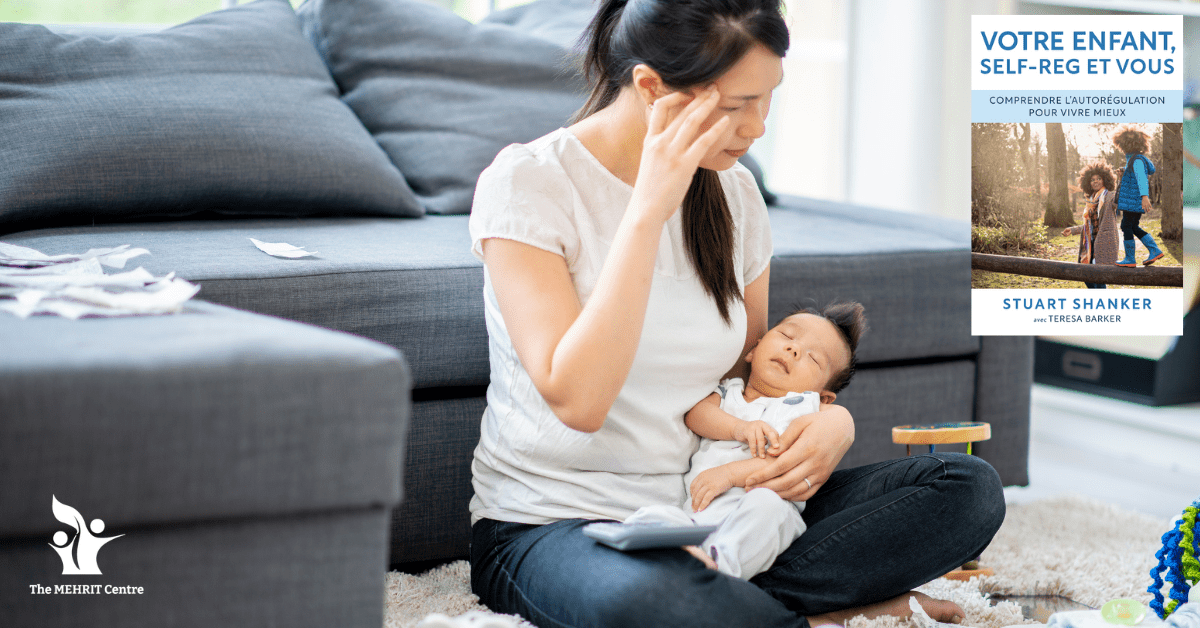
Let’s look into how to break the stress cycle with Self-Reg, exploring Stuart Shanker’s 2016 book in both English and in French!
Extrait du livre nouvellement traduit en français, maintenant disponible à l’achat – Votre enfant, Self-Reg et vous : comprendre l’autorégulation pour vivre mieux :
Fais plus d’efforts !
[…]
Être plus conscients de nos moments d’excès de stress et savoir comment rompre ce cycle aide à mieux nous autoréguler. C’est-à-dire on peut gérer les innombrables types de stress présents dans notre vie. Le système nerveux autonome (SNA) réagit au stress au moyen de processus métaboliques qui consomment de l’énergie. Puis le SNA met en place des processus compensatoires qui favorisent la récupération et la croissance. Plus notre charge de stress augmente, plus le processus de récupération est limité et par conséquent, nos ressources pour exercer le contrôle de soi diminuent et nos impulsions deviennent plus intenses. Mais dès que l’on pratique Self-Reg en comprenant la réponse naturelle du cerveau en cas de stress, le besoin même d’imposer le contrôle de soi disparaît le plus souvent. (pour accéder le reste du livre en français, cliquez ici)
Excerpt from the 2016 book Self-Reg by Stuart Shanker, recently translated by The MEHRIT Centre into French:

Try harder!
[…]
The more aware we are of when we’re becoming overstressed, and know how to break this cycle, the better we self-regulate. In other words, we manage the myriad stresses in our lives. The autonomic nervous system (ANS) reacts to stress with metabolic processes that consume energy. Then, it sets in motion compensating processes that promote recovery and growth. The greater our stress load, the more constrained this recovery process. As a result, the fewer our resources to exercise self-control and the more intense our impulses become. Once you understand the brain’s natural response to stress and practice Self-Reg, the very need to impose self-control often disappears. (continue to read the book Self-Reg)


2 Comments
Everyday stress and stressors – is there a list of examples relating to everyday?
Marriage, birth, birth of sibling, moving house, divorce, renovation, death, major illness or disease ARE NOT EVERYDAY SOURCES OF STRESS, and yet they are lumped in by gurus of all descriptions as being “normal” stressors.
Maybe this is why people do not cope and are seen as deregulated and disturbed.
Are people meant to adapt to unhealthy stressors? This is what they are being taught. Stay calm, over-ride body physiology when under attack?
Screaming teachers, bullying peers, hostile siblings and other
adults … Why are [we] adapting to these people and their behaviours? Is that not just a desensitizing conditioning that is actually maladaptive?
There are pro-social skills but that would depend on which social group and what is deemed social by that group. Children gossiping and teachers gossiping in the same environment would seem pro-social and acceptable. ?
I hear your frustration, and I appreciate your perspective. These examples came from learners reflecting on their own experiences, not as a justification but as a way to explore how different stressors shape behaviour. The goal is to understand what’s beneath the surface, not to excuse or normalize unhealthy stress or harmful behaviour.
Aviva