

This is the second in a series of blogs where I’m looking at influential parenting ideas through my own personal Self-Reg lens.
Most experts, and parents, would agree that good discipline is important in child-rearing. However, it depends what you mean by discipline. Our centuries-old self-control orientation constantly pushes us towards the mindset that discipline is primarily about enforcing behavioural rules and reacting to bad behaviour with punishment or consequences. Usually there is little or no consideration of the role that excess stress plays in a lot of the behaviour parents seek to address with discipline. One of the core Self-Reg ideas is that much of the behaviour that gets labelled misbehaviour is actually “stress behaviour”. So clearly there’s an incompatibility between rigid discipline approaches and Self-Reg.
Potential Pitfall
I would never say children don’t need reasonable limits or that parents should not address dangerous or hurtful behaviour. And, obviously, kids need to learn how to behave and be safe in the world helped by the care, guidance and teaching of their parents, caregivers and teachers. However, I’ve seen too many situations where discipline devolves into such a dogged focus on reacting to or fixing “bad” behaviour that the very behaviours parents were trying to fix become entrenched, and parent-child relationships are harmed.
One of the reasons discipline can backfire is that, when we’re dealing with a stress behaviour—which is often the case—the child is, by definition, stressed, i.e. on high threat alert.
a) a parent’s raised voice, punishment or attempts to control the child add to the sense of threat the child already feels. That makes them more likely to respond with fight or flight behaviours, which further fuel the already volatile situation.
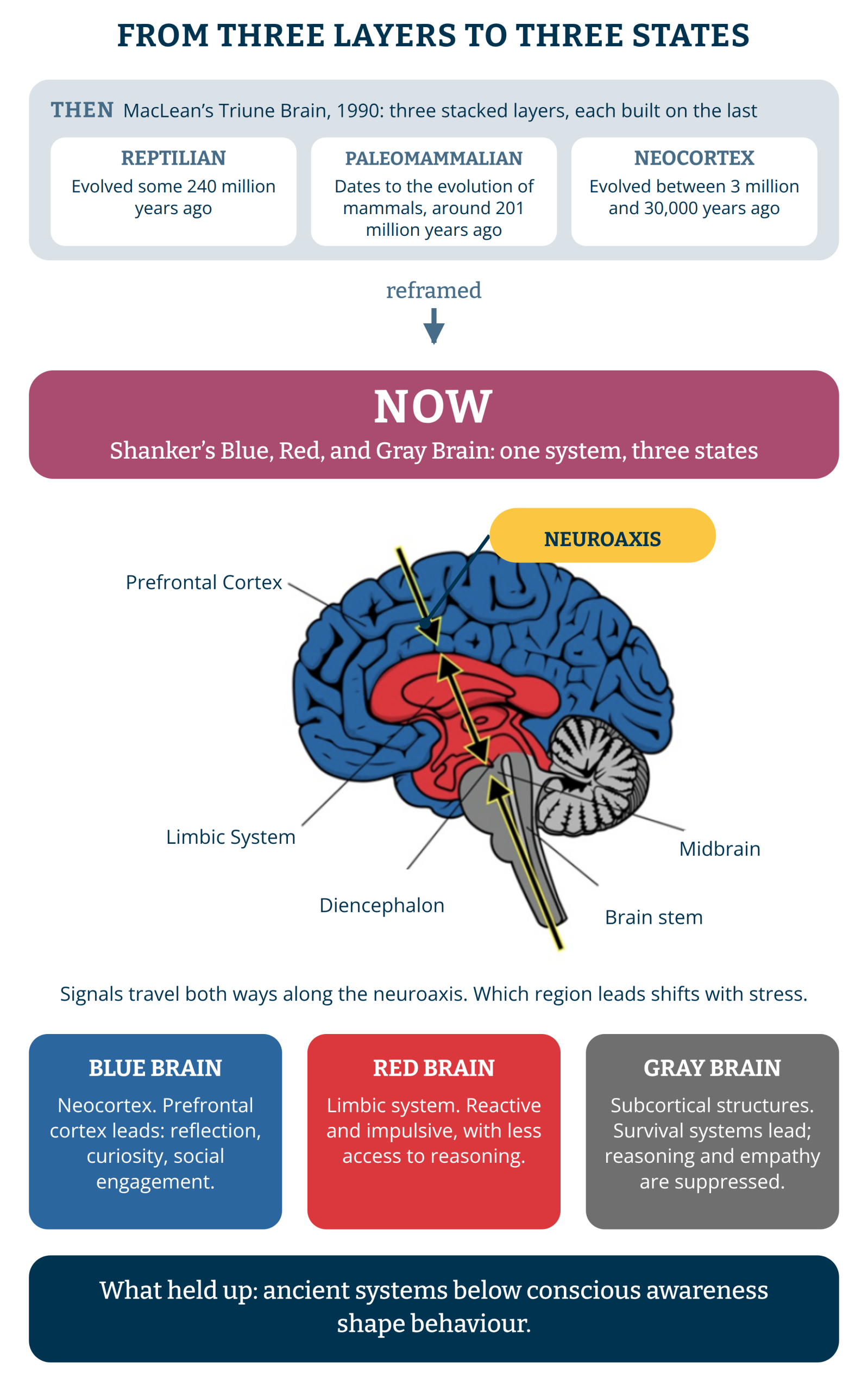
b) when a child is in that (red brain) state, they are not going to learn any discipline lessons. They’re just going to focus on protecting themselves. Relationships can suffer too, because the parents often feel they have to push harder and harder. So the child pushes back harder too. If these kinds of battles become a pattern, troublesome behaviours (and poor relationships) can become entrenched.
How Self-Reg Helps

If parents tune into and reduce kids’ (and their own) stress the sense of threat and tension gets dialed down. Parents will start to see their children differently. They will understand them better, develop better relationships, and spend more time helping their kids and less time fighting with them. That opens up new (and positive) ways to respond to behaviour. This is likely to be most important in families dealing with the most behaviour problems.
Make no mistake, parents are going to discipline their kids. They’re told, over and over, that they need to do it. And, sometimes kids do need to be stopped. Sometimes they do need consequences. But a Self-Reg “look for the stressors first” approach is the best tool I’ve seen for helping parents do less of the negative, coercive kinds of discipline that can become problematic for both parents and kids.
You May Also Be Interested In:
- Step Away From the Stickers Blog about the use of stickers as a reward system
- Self-Reg Parenting Course with Stuart Shanker, Susan Hopkins, Jean Clinton, Vicki Parnell and Self-Reg Parents sharing their parenting stories in action



14 Comments
We all need to have a calm approach to each and every child, whether he/she is your own. Like it has often been said in this course, a child cannot/won’t learn if there is a fight or flight they are experiencing.
Thanks for sharing your thoughts, Tan! What are some different ways that we might ensure our calm during high periods of stress? And what impact might that have on others? I’d love to hear your thoughts.
Aviva
The self reg “look for the stressors approach” is one that is key change are thinking from the behaviour to what is the stressors causing this behaviour. One huge takeaway for me through this course is about staying calm and lending each other our calm. Recently I was called to support a child who nneded a break and I went to help and the student must of senced my hightened state I had just let another high stress situation. When we got to the quiet space to have a break the student said can we just sit and talk. The student lent me there calm and when we were talking about what was happening in our day and how we were feeling. They said to me you looked stress when you first came is everything okay. This made me realise that I not only can lend my calm but I can use others calm to help me. It was a teaching and learning moment for both of us.
Thanks so much for sharing your story! This was a similar epiphany that I had when taking one of the TMC courses. I wonder if this learning will make you even more cognizant of your own stress in the future. How may we help others also be aware of their stress? I would love to hear your ideas.
Aviva
Suzanne,
Thank you for sharing your experience of the student leading their calm. I think this might be one of the key reasons that we are to incorporate others into our own self-reg.
Thanks for the comment, Heather! Have you ever had a similar experience?
Aviva
“See a child differently, you see a different child”, If parents tune into and reduce kids’ (and their own) stress the sense of threat and tension gets dialed down. Parents will start to see their children differently. They will understand them better, develop better relationships, and spend more time helping their kids and less time fighting with them. i enjoyed reading this article and learned a lot from this.
Thanks for sharing your thoughts on this, Baljit. I wonder how this might also apply to a classroom setting. Thoughts?
Aviva
Though I don’t have my own kid yet, I believe not every impulsive behaviour can be spared; they need to be disciplined. However, I will focus more on finding the root cause, not just leveling the behaviour first. I won’t say I would be successful every time, but I will keep trying. Not judging myself if I fail multiple times will be my motto.
Sarmin, thanks for sharing your thoughts here! Thinking about Self-Reg versus self-control, I’m wondering how this might impact on your thoughts around discipline. Thoughts?
Aviva
This article helped me see how stress can influence a child’s behavior. Instead of focusing only on discipline, it is important to understand what the child may be experiencing and respond with patience and support.
Thanks for sharing, Sara! I wonder if this shift also helps us see behaviour through a lens of stress behaviour vs. misbehaviour. What do you think?
Aviva
Discipline with love always works. It’s very important to show our kids that bad behavior has consequences. Once our child is regulated, talking with them is the best option.
Thanks for your comment! I’m thinking about stress behaviour vs misbehaviour. If we view a child’s behaviour through a stress behaviour lens, does that change our thinking around consequences? Thoughts?
Aviva