

By Meredith Sewell, Self-Reg Learning Facilitator’s Program Alumni
“There is only ONE WAY to LOOK at things, until SOMEONE shows us HOW to LOOK at them DIFFERENTLY”
– PABLO PICASSO
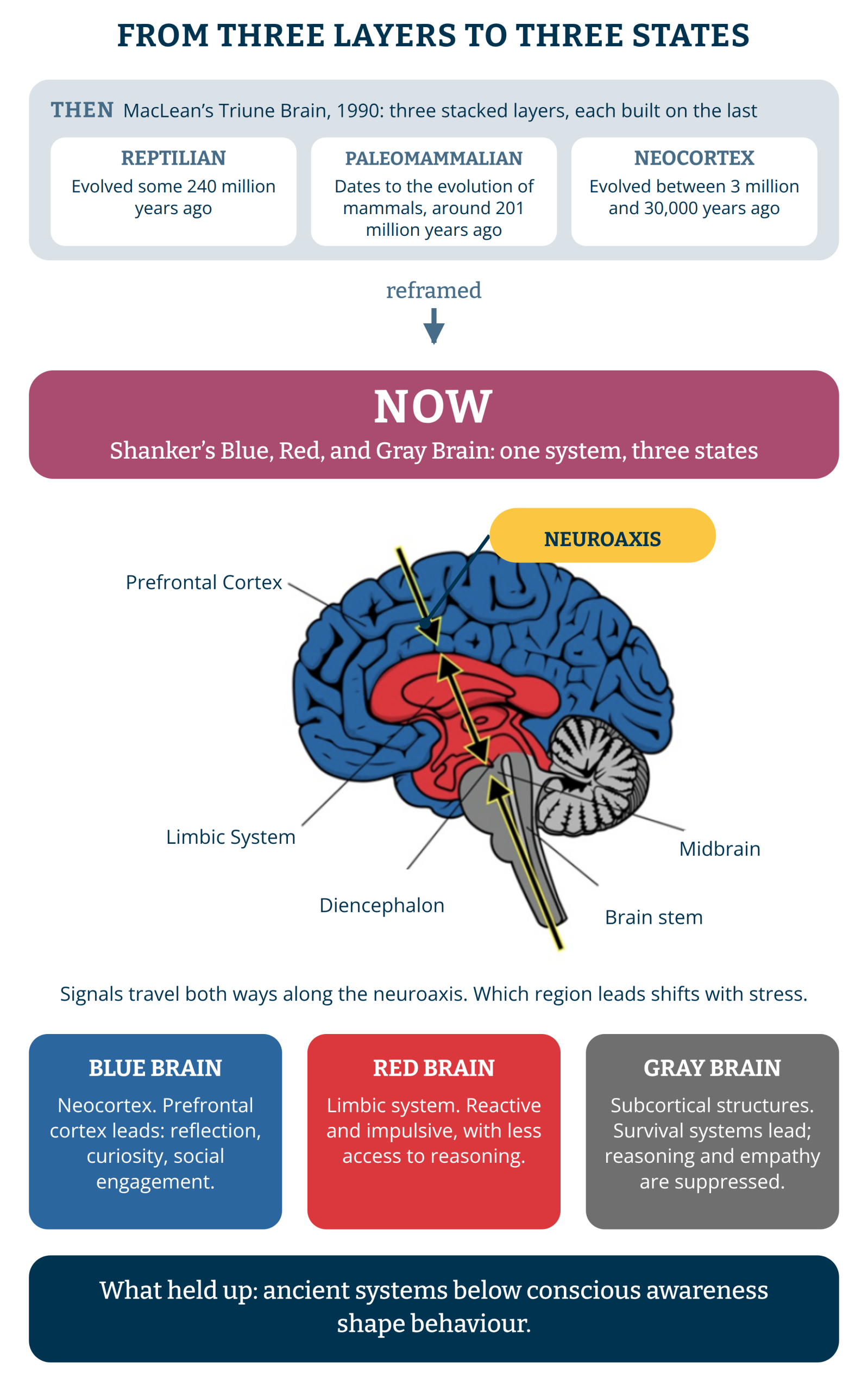
I was in my office at work one day and I heard one of our students yelling in the hallway. We often heard him crying, screaming, swearing, especially after recess. He would transition in three stages. Stage one was something that set him off outside at recess. Stage two was him being mad at the staff member who was engaging with him. Stage three was him being upset that he was going to be in trouble at home. It was a circular cycle. I seemed to be the only one to get his Prefrontal Cortex back online, I became his calm. I wasn’t concerned about him, it really didn’t take that long to bring his limbic arousal down when I sat with him, I was more worried about all of the adults who ideally played a large part in the length of his reaction. My goal was to work with the staff, and then we could move onto the stressors surrounding recess.
How was I going to help them reframe their own behaviour to help him?
The Staff: Understanding Stress Behaviour in the Child
What worried me about the staff’s responses were not only them verbally engaging with a little guy who clearly was unable to take in anything that they were saying, but they were responding in punitive ways: he was losing this, he couldn’t do recess, voices were raised and the list went on. Punitive measures in this case especially, puts more stress on him as well as all staff involved. I asked the staff what they were concerned about. They were worried about his swearing, his yelling, and most all him accusing them of something. Their limbic arousal was just as high as his. They were heightened just talking about it. One staff member even told me that I was too calm with him and that he was taking advantage of me. So, I asked a deeper question. Why does he do these things, and why at that time? Well there are many reasons: his peers, which game was played at recess, time of day, transition and much more. Is this misbehaviour? Is he aware of what he is doing and capable of stopping it? Well if he was then we wouldn’t be sitting here talking about it and it probably wouldn’t happen everyday. If it is not misbehaviour what is stress behaviour? Stress behaviour is when a child does something they are not fully aware of. They have limited to no capacity to act differently. The swearing and yelling are a hyperarousal state of fight or flight. He was verbally hitting out because his limbic system is in fight mode. He didn’t mean what was said, he was telling us “I am hurting, and I need help”. We know he was struggling to cope with the end of the day, from last recess on, many of the staff could not understand why he had such a hard time. They were not looking at how their own behaviours could make a difference. How do we reframe our own behaviours to better support the needs of this child?
Reframing our Own Stress Behaviour
How we react to children is so important, in what we say, how we say it and our body language. It is human nature to respond in the immediacy of what we think is misbehaviour, we too can go into limbic arousal. Who wants anyone to treat or talk to them the way this little boy does almost everyday? Definitely not the staff who support him. It is historically ingrained in us that adults are authoritarian, ‘children should and will listen to us’. It is a negative bias we often fall into, when what we really need to understand is how our actions affect the stressors the child is dealing with. I asked the staff what their reactions were. I knew what some were but I wanted them to reflect. The answers were honest, some said they raise their voice, others said they take things away, some even agreed they argued. I then asked why they did these things, and if it worked? Well they all agreed that the punitive approach was not working, 4 out of 5 days we were seeing the same behaviours. As for why, none of them could really answer me. This made me dig deeper, if I want them to answer ‘why?’ and ‘why now?’ for the little boy, they should be able to answer ‘why?’ and ‘why now?’ for their own stress behaviour. We did an exercise, the morning, midday and the afternoon. We had to talk about each part of the day. We discovered that the staff worked themselves up to that recess beginning each morning, in hopes to prepare for what was most likely going to happen (the little boy’s behaviour after recess). They were in such a fight mode by the recess itself that their own prefrontal cortex was just as offline as his. A lot of “wow we never thought of that before” was heard when we actually talked about their stress response. So now let’s talk about how reframing our own outlook and responses can help a child.
How Reframing our own Behaviour can Make a Difference
Our first couple of steps in reframing are seeing the difference between misbehaviour and stress behaviour and asking ‘why?’ and ‘why now?’. Instead of reacting to a problem, let’s flip it on its head, make it a positive. If we ask the right questions around a situation and start seeing the stressors in the five domains as they appear in ourselves and a child, we can start to understand what we need to do. We need to hear these behaviours as a cry for help and not assume a child is “BAD”. In the case of this little boy, he doesn’t need us to keep telling him what he needs to do or what he is doing wrong, he needs us to be calm and not overuse verbal language. He needs us to help him shift back into the thinking brain. If the pre-frontal cortex (PFC) is offline, anything we say is not being heard. We often turn to problem solving, more of a fix the problem instead of working with the stress behaviour. Recognize that these children are not problems, they are showing us coping mechanisms and we need to help them reframe. Don’t beat yourself up over things that have happened, learn from situations and be willing to learn from a child. When something does not work, we need to go back and reflect on it, be willing to understand that it didn’t work and why. We need reflective growth to reframe our own initial stress response.
“If we see a child differently, we will see a different child”
– Dr. Stuart Shanker
Let’s Give it a Try
If adults in our classrooms are not willing to reframe their own behaviour we will not be able to help children with high stress behaviours. We need to lend our calm to children with a heightened limbic system, not join them in the arousal. If something is not working, chances are it never will. So, being open-minded and looking at behaviour as stress behaviour, it may paint a clearer picture of ‘why?’ and ‘why now?’. We have lost sight of the fact that we are working with children, something that may not be a big deal to us may be a huge deal to them. If we cannot gain their trust, if they don’t feel safe, how can we help them respond differently? We as adults should be able and willing to see past the behaviour and see what is beneath it. Kids are not born bad but they are born with stress and it won’t hurt anyone to give reframing a try.
You may also want to check out our 6×6 series which explores Self-Reg from the lens of 6 different roles in a school. Watch the free series HERE.


29 Comments
<3 Beautiful. I loved the details and how you turned the lens so gently towards the adults.
Thanks for sharing, Nino! How do you think others might be able to use this post to support their own classroom experiences? Thoughts?
Aviva
I am happy to say that our district is starting to really make debriefing with staff back in focus as part of our best practices after an incident with a child occurs. Being Proactive in learning what the student is trying to communicate stressors.
Getting to the “why” is coming back into focus, we can do better serving the students needs in the moment when we know the “why” of the behavior. Discussing what worked and what didn’t through a no blame or shame approach and lens, recognizing how our own actions can play in either providing the calm or causing further arousal.
Thanks Kim for your comment! I agree with you about the importance of the “why” and recognizing our stress as adults (and the impact we can have on the students in our care). I wonder if other districts will explore this more with staff. It would be great to hear different stories and the impact on these kinds of conversations.
Aviva
I really like this article as it again reminds us, that in essence, we get what we give, meaning if we are heightened, that energy often reflects from the student back to us like a mirror and can amplify; we need to see the communication in the behaviour, not the chaos.
Thanks Dawn-Marie! I agree. How do we consistently recognize when we are heightened and find our own calm? What do you think?
Aviva
The article made me remember that some of are students come to school with stress triggers from home. If we don’t approach the students with kind ,caring and supportive way that this could lead to outbursts of yelling,running and them shutting down. There maybe times that we don’t know the main “WHY” because the student may have many things triggering them at once. So by giving them a safe environment to calm themself and to let them know you are there for them. We can then learn some of their “WHY’S”. Children can see are calmness in our body language and hear it in the tone of our voices. So for us adults it is also important to let children see that we also have time we need to self-reg.
Thanks for the comment, Debbie! You make some really great points here. I wonder how we always find our calm when classrooms or schools can feel dysregulating. Thoughts? What works best for you?
Aviva
I worked with a student who can not help his stress behaviour. At first, I became stressed out myself and dysregulated. In learning why this child was behaving the way he was, I looked at him differently. He taught me how to be more calm and gave me a lot more patience. I was learning how to be a co-regulator without even knowing I was. This self-reg is awesome! I love it.
This is so fantastic to hear, Amanda! I love reading about how your perspective changed. I wonder if others have had similar experiences.
Aviva
Thank you for that insite. I totally understand how that works. I have had many situations where my student would swear, yell, distroy anything in his way and witnessed the adults tending to him try to control him. It made this child even more stressed. They were all talking to each other about what he’s not a loud to do. There was no calming him. I did exactly what is reccommended in the story. I lent the student my calm. I said nothing to him but ‘hi D, I’m here for you. I waited, and while he was processing I did my deep breathing load enough for him to hear and remember what we do when we are feeling out of control. It didn’t take long and we were able to leave the room calmly, but with lots of tears. I was so greatful to be there for him. I did debrief with the other staff, reminding them that all he could hear was alot of noise. It’s important to remember sometimes not doing anything but being there in your calm can be a hudge benefit to the child. Thank you for the story, it truly resonated the with me.
Thanks so much for sharing your experience! I love hearing about how the story resonated with you. I wonder if by sharing your experience, you will inspire others to also do the same.
Aviva
Well said. This was very timely for me. I find myself in the situation at work.. I am new to the school, but my student is not so I have found that there is a bit of a negative narrative around their behaviour and them and I’ve begun to question another professionals and people around me to hopefully turn this around for them.
Thanks for the comment! This is a good reminder that sometimes a little wondering aloud can also help with changing perspective. I also wonder if it’s sometimes our feelings of stress around kids that exacerbate problems. Thoughts?
Aviva
The article highlights how our own stressors affect students the their stressed behaviour situations. I have to admit that shift to deal with the stressed behaviour is a long process and reflecting on how to deal with this differently is helpful. My big challenge in this process is to find a balance between stressed behaviour and my reaction to it. Hopefully I will learn more about it through the course.
Thanks for your comment! This was some big learning for me too when I took the course. It reminds me of a conversation I had this morning. Kids can read our stress and this sometimes increases their behaviour, but sometimes we need that behaviour to settle in order to reduce our stress. There’s definitely a cyclical nature here. I wonder though, if being aware of these feelings of stress can also help with reducing them. Thoughts?
Aviva
I appreciate that in this story, you said how can I help the staff reframe all behaviour. Instead of becoming defensive you responded with a why and why now to the childs and staffs behaviour.
Thanks for your comment, Heather! It’s amazing how adult and student stress are so interconnected. What do you think?
Aviva
Such a great reminder that we are basically the ‘first responders’ when it comes to a child in need of our assistance and behaviours are never just for no reason. Calm breeds trust and can be shared.
Thanks for the comment, Rhonda! I wonder how we might be even more aware of our “calm” in order to support others. What do you think?
Aviva
Loved reading this! We can really be the captain of the emotions in the unpredictable sea of life. When we can master our emotions they can then master theirs as well.
Thanks for your comment, Brandie! What helps you with managing your emotions? I would love to hear more.
Aviva
In my opinion, we need to remember that our reactions matter just as much as a child’s behavior. We need to stay calm and take a moment to reflect before responding. For me, it was a strong reminder that we have to work on our own stress first if we truly want to support children in a positive way.
Thanks for sharing, Yuliia! How do you help reduce some of your own stress? I would love to hear more.
Aviva
I loved reading this! It really shifted the focus from children to adults—staying calm, being collective, and taking a moment before responding can make such a real difference.
So glad that you enjoyed this post, Sarmin! How might the ideas shared in here influence any choices that you make? I would love to hear more.
Aviva
Thanks for sharing about your experience. I would love to hear more about the impact these choices had on you.
Aviva
My biggest takeaway from this article is that adults need to reframe their thinking first. If we see behaviour as “bad,” we react differently than if we see it as stress behaviour. I learned that asking “why?” and “why now?” is important not just for the child, but for ourselves too. If we are stressed and reactive, we can make the situation worse. When we stay calm and change how we respond, it can really help the child feel safe and regulated.
Thanks for your comment, Kaya! I think that there is so much learning potential here for all adults. How might we share this thinking with others? Have you done so before? I would love to hear more.
Aviva