As much as we might know — or have learned — about Self-Reg, I love how we can always be reminded about the need to view children, adults, and behaviour differently. I had one of these experiences recently, and I knew that it would inspire a blog post.
The Spark …
At both of my schools, I’m on a cart and travel around the buildings like the “Reading Roadshow” to support literacy learning. This means that I’m on a tight schedule: usually about 20-25 minute time slots in each classroom. I don’t often have time for a whole lot of extra. On this day though, a teacher candidate in another classroom was shadowing me for the morning, so I took those few extra minutes to connect with her, answer her questions, and talk through some of the choices that I make. We happened to be about to visit the classroom next to hers for some small group time, when she noticed a student leaving her room and going into her locker. She asked if she could go talk to her. She came back a few minutes later and said that she tried different ways to get her to leave her locker, but nothing was working. It was almost nutrition break, so I said that I would give it a try.

Approaching The Locker
I happen to know this student fairly well. She was in some of my groups last year and again this year. We have a positive relationship, which I know is the backbone of Self-Reg. I went and knocked on her locker door and slowly opened it a bit more. She looked visibly upset, and I mentioned this. I asked her if she wanted to talk about what happened. She shook her head — no. I really didn’t want to get into a power struggle, but I also didn’t feel comfortable with her spending the break in her locker. Then I remembered a recent conversation that I had with the Resource Teacher, and I had an idea.
The Resource Teacher had a great talk with this student recently, and the child said that she would feel so much better if she could “call her mom at school, just to say, ‘hi.'” They were looking at a way to make this work. I thought it was worth a try, so I said, “Do you want to come downstairs with me to call your mom?” She smiled … yes!
Moving And Connecting
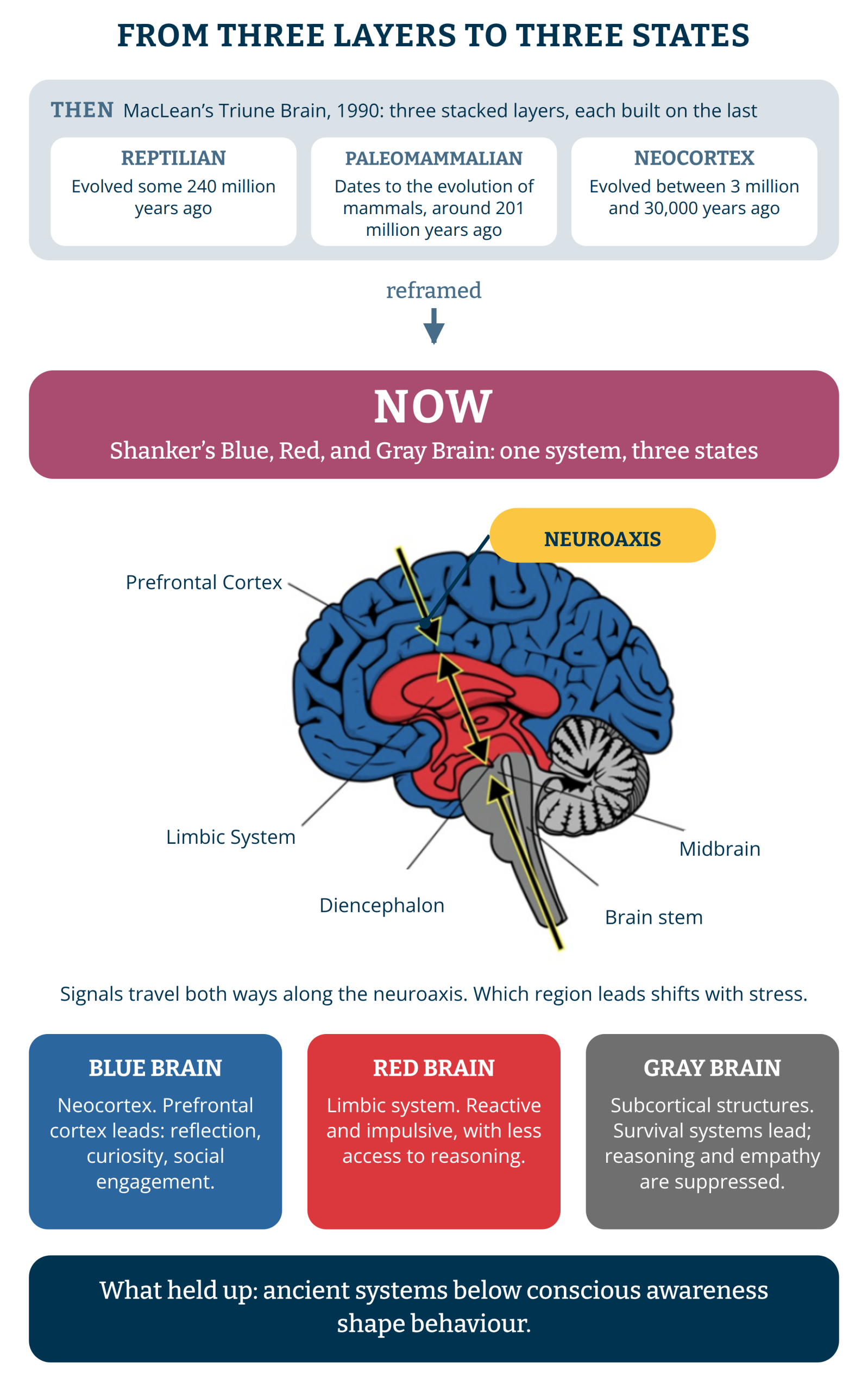
I mentioned to this student that I needed to take my cart back downstairs, so I asked her if she would help me push it to the elevator. She did. As we pushed the cart and then walked down to the stairs to meet the elevator, we spoke. She was initially reluctant to tell me about what upset her, but when I said, “I was just hoping to know so that I could help make things better. I really care about you, and it makes me sad to see you sad,” she told me more. This student explained that a child in her class was upset, so she went to help her. There was a substitute teacher, and according to this child, the teacher was not happy that she was over at this other child’s desk space helping her out. Maybe these feelings are accurate. Maybe this student was stressed, and in a “fight, flight, or freeze” mode, our perceptions of other people’s feelings can vary. (I remember Stuart Shanker sharing this in The Foundations course.) Regardless of the details, this is how the child felt and this is what led to her actions. This is when I asked, “What can I do to make things better?” She said, “Calling my mom and talking to her will help,” so this is what we did.
Or at least, this is what we tried to do …
It turns out that mom’s phone was off, and we couldn’t get through. We tried a couple of times with no success. Now what? I wondered about writing mom. I know that reading and writing can be challenging for this student, so I showed her how to use the microphone on the tablet to write the text. She loved this, and she especially loved adding so emojis. I said that I would come up to her class and tell her if mom wrote her back, so she needed to be there so that I could find her to share the news. This worked!
Changing Trajectories
Usually this child finds it hard to spend the day in the classroom, but she was eager to see if mom would write her back. Best of all, mom did, and I went to share the note with the student. This led to another written exchange. I loved seeing this student so happy. I also loved that she could work through a challenge and change her trajectory for the rest of the day.
Looking Back At This …
Looking back at this experience now, I’m so grateful for the Resource Teacher who inspired my actions on this day and changed things for this child. It would have been easy to see this student’s behaviour as misbehaviour, and I’ve done exactly that in the past. I’ve gotten frustrated with children who wouldn’t listen or continued to stay where they shouldn’t stay. Seeing a child differently though, also helps us see behaviour differently.
Relationships are key, and I’m grateful to be in a teaching position where I get to build these relationships with so many educators and students. When are some times that you’ve seen kids and behaviour differently? What was the impact of how you responded to this? The more that we all learn about Self-Reg, the more that we view our world through this lens.