

The Triune Brain is one of the key scientific underpinnings of Shanker Self-Reg®. Developed by neuroscientist Paul McLean, the Triune Brain model has proven very useful in helping educators, parents and others who work with children. It’s a tool help understand and respond more supportively to behaviour and mood challenges like explosive behaviour, aggression, persistent crying, defiance and tantrums.
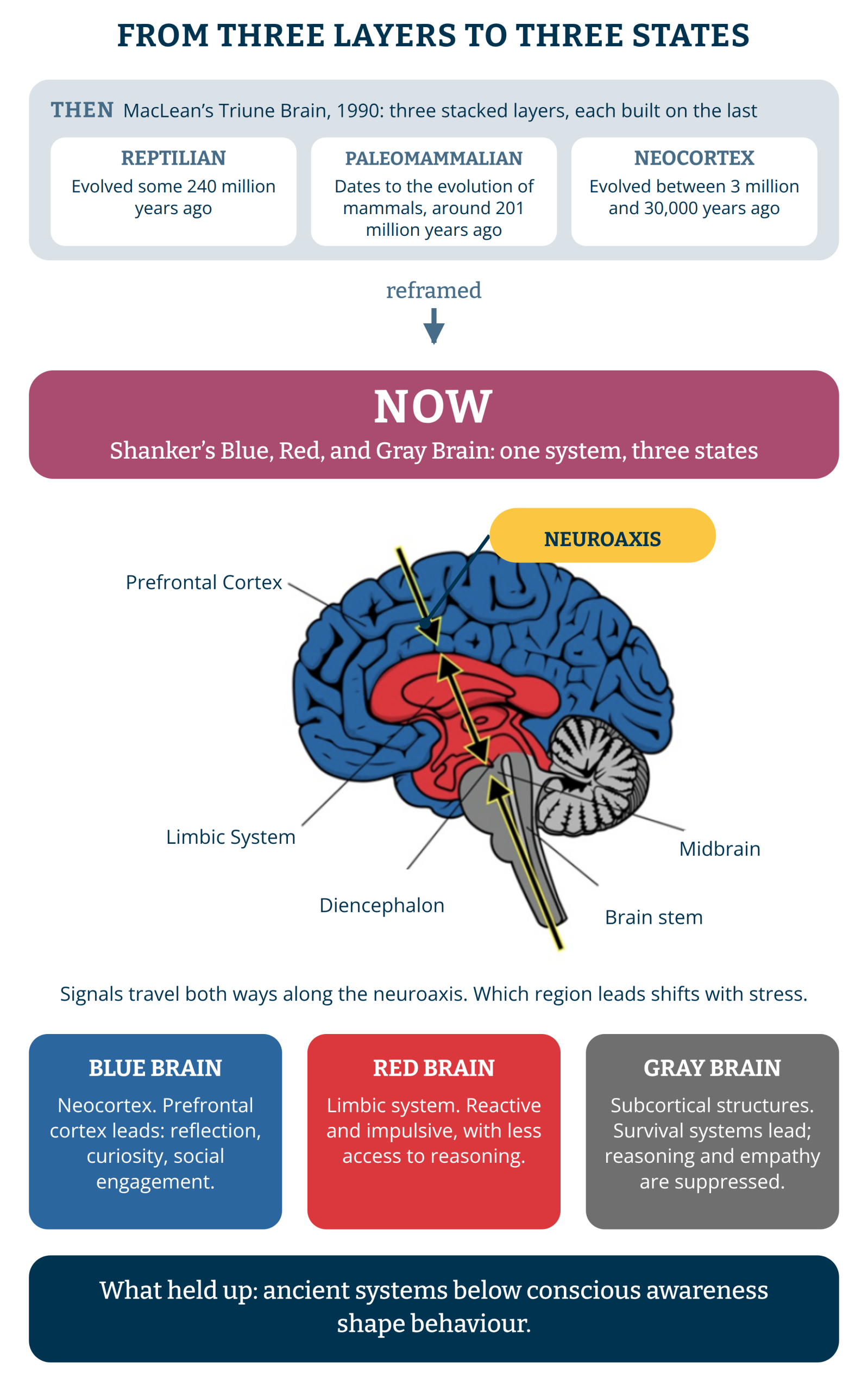
The Triune Brain metaphor describes the human brain in terms of three dominant evolutionary systems/structures:

- the Reptilian brain (Gray Brain): regulates basic motor and metabolic functions necessary for survival such as heart rate, breathing and body temperature
- the Paleomammalian brain (Red Brain): the home of primitive and/or strong emotions and urges, spotting enemies, initiating the fight-or-flight response
- the Neocortex (Blue Brain): supports thinking, planning, listening, speaking, engaging socially and being consciously aware of what is going inside us and around us
You can learn more about the Triune Brain in our Self-Reg Foundations Program which explores the Triune Brain in depth.
Dive Deeper with our blog Reframing Challenging Behaviour & program Reframing Stress Behaviour with Gray Brain Science.


4 Comments
The triune brain metaphor ought to be abolished.
What is it based on – research on animals that instinctively behave for survival? Knock-out mice? Sabre-tooth tigers?
Humans are being kept in the dark ages by having their brains related to in terms of fight, flight, freeze, (faun), behaviours, as observed in the animal non-human kingdoms. Maybe this analogy is in and of itself causing problems?
Human physiology can surely be explained in human terms – ?
Why the need for unrelated metaphors?
If physiology is achieved via co-regulation it is the adults relating to or reacting to children who need to be co-regulted into calm, civil, caring interbrain interpersonal interactions.
Parents become lost with their skills which once worked just fine, when dramas and chaos originating in schools’ environments are not addressed promptly and effectively and compassionately in real time. Pent up injustices et cetera from such environments make their way in to family life where skills and resources are limited.
Childcare, preschools, educators, teachers, principsls, administrators all such persons need to address their own internal stress reactions well before they start pointing fingers, blaming, scapegoating, and giving threats and punitive directives.
For sure parents would be left to and able to parent what is their responsibility to do. And not have to take on responsibilities handed over by those not wanting them.
You are right, it is not the infant, toddler, child, adolescent, teenager with the pathology – the pathology has been taught to them by the staff mindsets and attitudes in institutions, businesses.
Appreciate your perspective! While the Triune Brain model has its limitations, understanding bottom-up processes—especially the role of the subcortical (gray brain) in self-regulation—goes far beyond fight, flight, or freeze. I’d encourage exploring more recent insights into how these systems shape our responses and well-being.
Aviva
In my practice as a psychotherapist, this language for understanding the different brain states and how they impact our functioning and wellness has been really helpful. We could use more technical terminology, sure, but this metaphor helps people to understand the bottom-up processes that go beyond overly cognitive (blue brain) approaches. We look at how our brains and bodies work together to contribute to the wellness balance. This metaphor helps us to reframe and look at ourselves with soft eyes.
I love your comments about co-regulation. By using the language of red brain and blue brain and gray brain, I help clients see how the relationships and connections with those around us can provide the neurological safety needed to shift and balance the different brain states. When we can understand the science in simpler terms, we have a broader reach in helping folks to help themselves!
Thanks for your reply Casey! I really appreciate hearing more about the science. I know this is definitely an area where I continue to learn.
Aviva
Trackbacks/Pingbacks