Blog by Self-Reg Learning Facilitator’s Program Alumni Kaitie Westbrook
It was one of those farm days—the kind where everything needs to happen at once – or so it seems. The sun beat down as the fields buzzed with activity, and the air was thick with the urgency of harvest. The kids were right in the thick of it, eyes wide with excitement, soaking up every moment of their day helping on the farm.
But in the middle of all that hustle and bustle, something unexpected happened.
Their great uncle, juggling the weight of the day, the time and weather forecast, made a split-second mistake. The arm of the combine swung out too soon—BANG!—a jarring crash as it slammed into the side of the shed, bending the metal and bringing everything to a halt.
What unfolded next wasn’t just a moment of frustration—it was a living, breathing lesson in affective neuroscience, witnessed through the clear, compassionate eyes of two children.
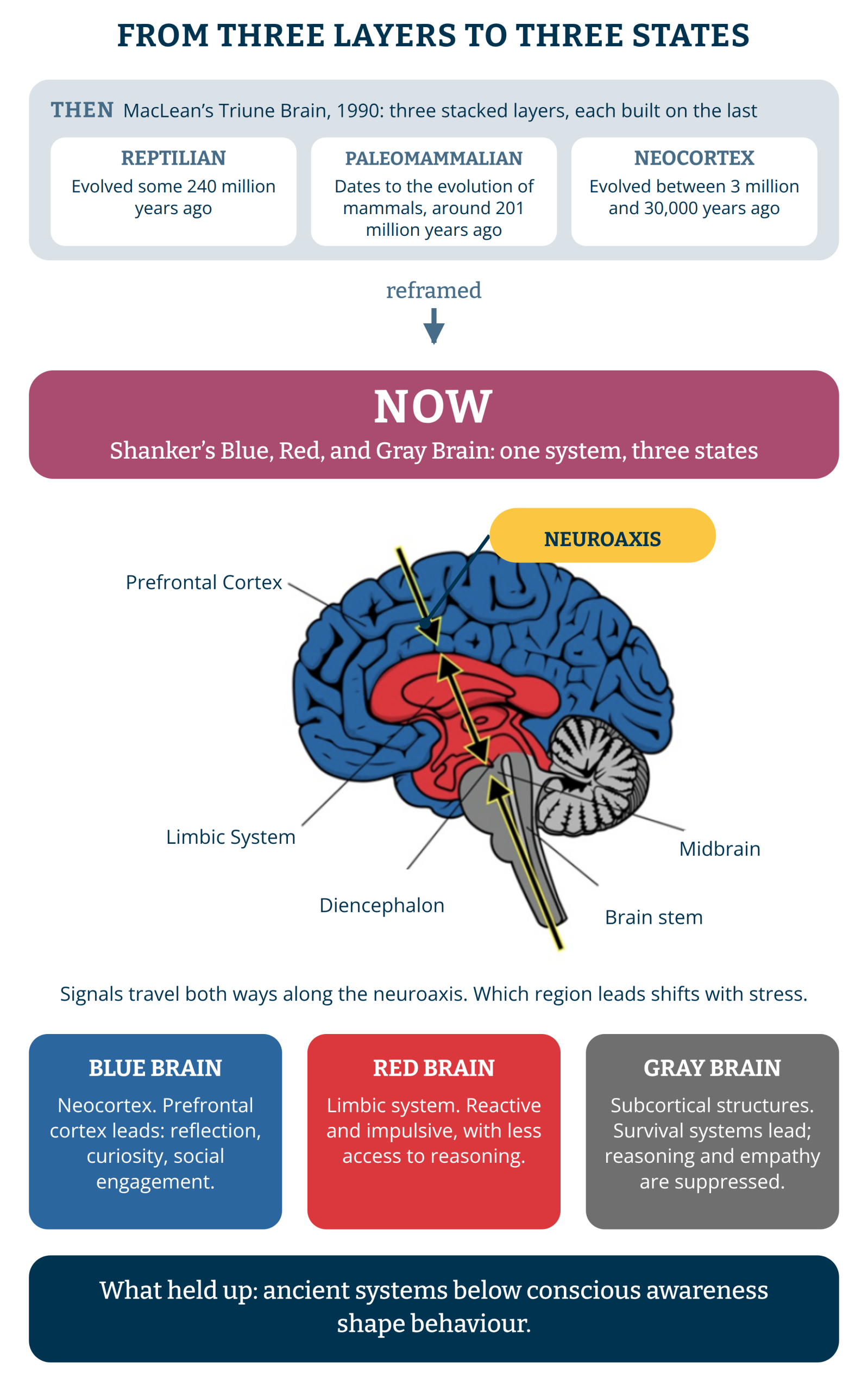
They described watching their great uncle’s face twist as his head thrashed back and forth in frustration. But more than that, they felt the shift. They saw that he was mad at himself. “He was shaking his head and fists really hard.” What they were witnessing was the activation of what neuroscientist Jaak Panksepp called the RAGE circuit—one of the seven primary emotional systems hardwired into our brains.
The RAGE system, rooted deep in the brain’s subcortical regions, is designed for survival. In humans, it can be triggered by frustration, blocked goals, or perceived injustices—like a bent combine arm on a long, hot day.
But here’s where the story takes a Self-Reg turn. My son, sensing the stressload and emotions, turned to his sister and said, “Give him a jelly bean. It’ll make him feel better.” Without hesitation, she offered him an orange one—”to make him happy again,” she explained later.
And it worked.
He accepted the tiny gift with a smile, his body visibly reduced the tension and he pulled both children into a big hug. At that moment, the CARE circuit—another of Panksepp’s primal systems—was activated. This circuit, responsible for nurturing, bonding, and social connection, soothed the RAGE response, calm returned, a brief moment of restoration occurred and the work carried on!
From a Self-Reg perspective, this moment was a perfect example of co-regulation. The children, unburdened by adult stressors, intuitively offered connection and comfort. Their gesture wasn’t just sweet—it was neurobiologically powerful. They helped shift their great uncle from a state of high arousal and emotional dysregulation to one of safety and connection for regulation!
Children often see what we miss. They don’t just observe behaviour—they feel the emotional undercurrents. And when we allow ourselves to see through their lens, we’re reminded of something profound: that healing doesn’t always come from fixing the problem. Sometimes, it comes from a jelly bean, a hug, and the quiet wisdom of a child who simply wants someone to feel better.
References:
Panksepp, J. (2013). The archaeology of mind: Neuroevolutionary origins of human emotions. W. W. Norton & Company.Learn more: Shanker, S. (2025). Reframed: A self‑reg revolution (Rev. ed.). University of Toronto Press.