From Susan Hopkins, EdD | Executive Director
This reflection was originally published in The MEHRIT Centre newsletter. Sign up for our newsletter to receive Susan’s latest reflections, Self-Reg insights, and updates directly in your inbox.
Have you ever watched a sweet moment with a child turn into a standoff in minutes?
The night before a talk, I went down to the hotel pool, hoping to get a little swim in. So did about ten young hockey players, in town for a big tournament across the street. Ten six- and seven-year-olds in a hotel pool? It felt like thirty. I love kids, but ooh. You can imagine what it was like. After a while they all left, and the only ones still there were a dad and his son, who I’d guess was about three. They were going back and forth between the pool and the hot tub, and they were really enjoying themselves. It was really kind of sweet.
Then the door swung open and big brother, maybe six, walked in. You could see he was really depleted. “I’m hungry.” Dad told the little guy it was time to go. He said yes, paddled over to the stairs, then turned around and swam right back out. Then he did it again. And again. Big brother’s voice got louder and sharper each time, and Dad’s loud whisper got more urgent. I couldn’t hear the details, but I could tell the carrots and sticks were coming out, the little rewards and threats we all reach for when we need a child to do something.
Then, in the middle of it all, the little guy looked over at me with the biggest grin on his face.
It’s easy to call that misbehaviour. But what on earth was going on with all three of them?
Why this? Why now?
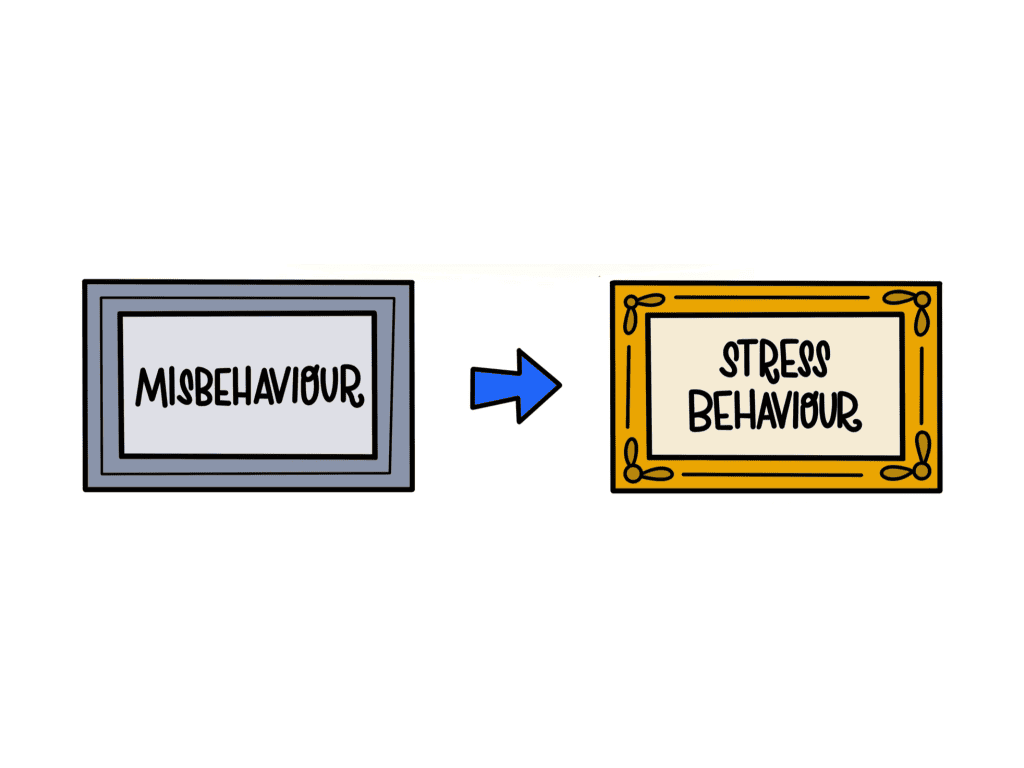
Once you start learning Self-Reg, you can’t help getting curious about a moment like this. Why this? Why now? Stuart Shanker describes a stressor as anything that requires us to burn energy to stay in balance, and from where I was in the pool, I could see possible stressors everywhere.
Big brother was hungry, and I think he’d been playing in the tournament all day. Waiting is a stressor. So is a little brother who keeps saying yes and swimming away.
Dad’s lovely moment had slipped away, with two boys pulling in opposite directions. In a space that small, he may well have been aware of a stranger nearby. Most of us know what it feels like to handle a hard moment with someone watching.
And the little guy? I keep coming back to him. Why would he do that? Maybe it was a game. Perhaps he just wasn’t ready for the fun to end. Or all the urgency around him might have made it harder to come out. There are a million possible whys, and I don’t know which it was.
What I do know is that getting curious opens up far more ways to respond than deciding it’s misbehaviour and stopping there.
A towel and open arms
Then the door opened again. A woman I took to be grandma walked in, took one look, picked up a towel and held it open. The little guy ran straight into her arms, and off they all went.
I don’t know how the rest of their night went. What I keep getting curious about is why that worked when nothing else had. Carrots (a treat, extra TV time) and sticks (a timeout, counting to three, taking something away) tend to fail us right when we need them most, because a brain-body that’s this depleted has very little room left for a bargain or a threat. Grandma walked in from outside the tug-of-war, calm, and offered warmth instead of pressure. That’s co-regulation, and it did in seconds what all the negotiating couldn’t.
Noticing what works deserves the same curiosity we bring to noticing stressors. What was it about that moment, that person, that towel? When we understand why something helped, we can do more of it.
These ideas are at the heart of two of our courses. Applied Self-Reg for Educational Assistants starts in a couple weeks and is for anyone supporting students in K–12, the people who are so often the adult right there in the hardest moments. Leadership for Self-Reg Schools is just getting started and looks at how leaders can create the conditions where the adults have the energy to co-regulate at all, and there’s still time to join.
A question to mull over
Think of a moment when nothing you tried was working. What stressors might have been in play, for everyone involved? And when something finally did help, what was it about that moment?
Keep exploring
- Applied Self-Reg for Educational Assistants — Starts November 7. Explore the stress behind students’ behaviour and ways to offer support in the moments that feel hardest.
- Leadership for Self-Reg Schools — Began October 22, with time to join. Explore how leaders can create the conditions for adults to feel supported and have the energy to co-regulate.