
Self-Reg Publications



REFRAMED: A Self-Reg Revolution
By Stuart Shanker | 2025
For Stuart Shanker, the possibility of a truly just and free society begins with how we see and nurture our children.
Shanker is renowned for using cutting-edge neuroscience to help children feel happy and think clearly by better regulating themselves. In his new book, Reframed, Shanker explores self-regulation in wider, social terms. Whereas his two previous books, Calm, Alert, and Learning and Self-Reg, were written for educators and parents, Reframed, the final book in the trilogy, unpacks the unique science and conceptual practices that are the very lifeblood of Self-Reg, making it an accessible read for new Self-Reggers.
Reframed is grounded in the three basic principles of Shanker Self-Reg®:
- There is no such thing as a bad, lazy, or stupid kid.
- All people can learn to self-regulate in ways that promote rather than constrict growth.
- There is no such thing as a “fixed outcome”: trajectories can always be changed, at any point in the lifespan, if only we have the right knowledge and tools.
Only a society that embraces these principles and strives to practice them, argues Shanker, can become a truly just society. The paradigm revolution presented in Reframed not only helps us understand the harrowing time we are living through, but inspires a profound sense of hope for the future. Shanker shows us how to build a compassionate society, one mind at a time.
Previously released in 2020 as REFRAMED: Self-Reg for a Just Society
Shanker Self-Reg Chronicles: Restoring Resilience
By Stuart Shanker, Anne Showalter & Susan Hopkins | 2025
Restoring Resilience provides answers to why our children and youth are struggling and strategies for building lasting and true resilience through Shanker Self-Reg®.
Based on new research in the neuroscience of stress and self-regulation and developed foranyone supporting children or youth, this book completely shifts thinking about resilience,stress, and how to care for children and youth with compassion and connection.
Stuart’s groundbreaking analysis of neuroscience research, along with practical examples andreflection tools, will help you to learn:
- How stress affects the brain
- How stress manifests in our minds and bodies
- How the to use the five steps of Self-Reg can build resilience
- The power and restorative impact of co-regulation.
This book, along with The MEHRIT Centre’s course Enhancing Resilience in Children and Youth will give you the keys to finding calm in yourself and in children and youth, no matter how much stress comes your way.
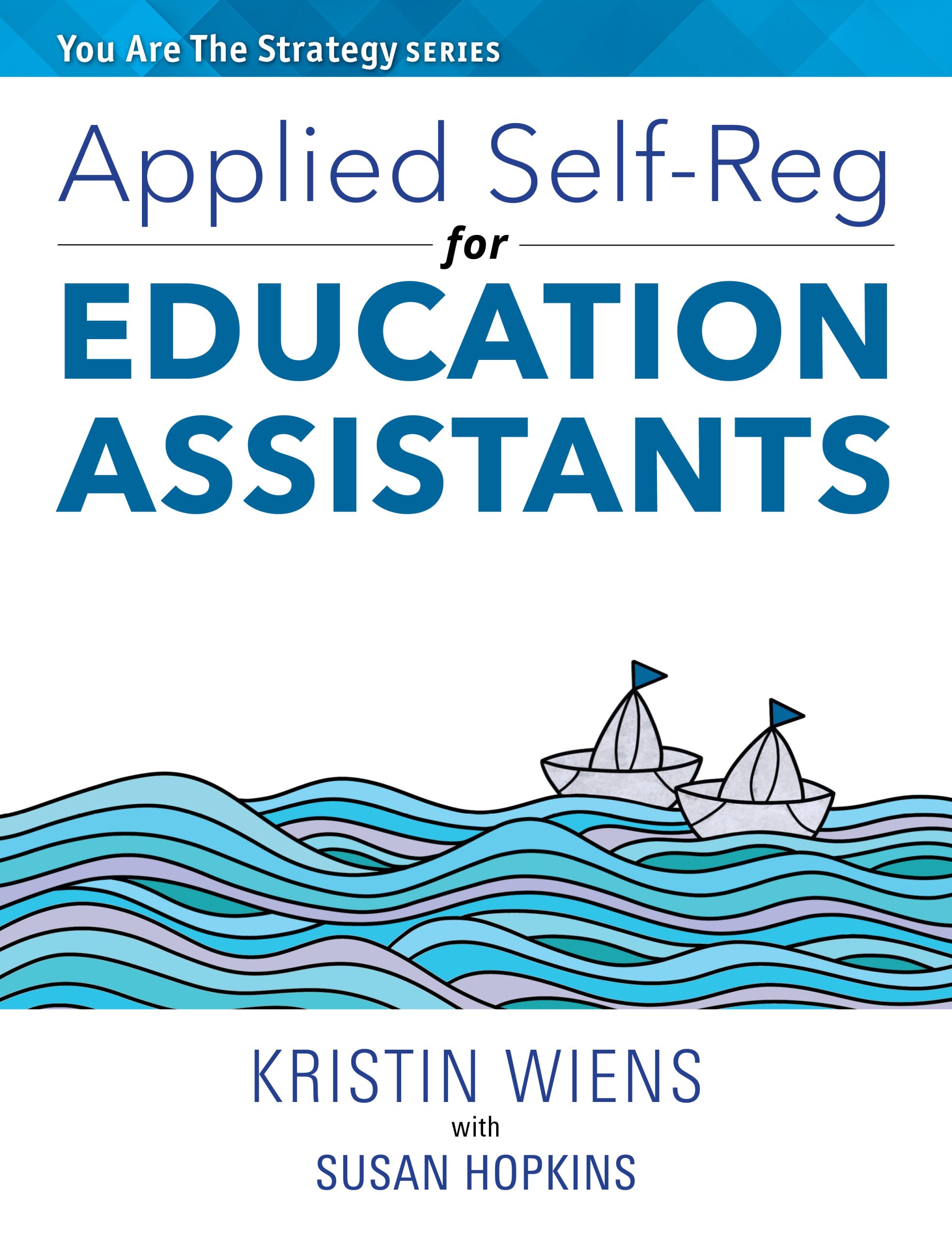
Applied Self-Reg for Education Assistants
You know the moments. Something shifts. A student pulls away, shuts down, or suddenly pushes back. You feel it before anyone says a word, and you still have to respond.
Applied Self-Reg for Education Assistants is a practical, neuroscience-informed book grounded in the work of Dr. Stuart Shanker and the Shanker Self-Reg® framework. Written for those working in education support roles across K–12 schools, it offers a clear Self-Reg lens for understanding what is happening beneath behaviour and how to respond in ways that support learning, engagement, and well-being.
Through real stories, visuals, scenarios, and flexible strategies, the book walks readers through how Self-Reg is applied in everyday school situations. The focus is on approaches that can be adapted across students, needs, and contexts, helping support teams respond with greater confidence, clarity, and steadiness over time.
This book is for the people who are right there when things get hard.
Education assistants. Paraprofessionals. Child and youth workers. Classroom and learning support staff. Behaviour support roles that go by many names but share the same reality: being with students in the moments that matter most.
If you’re dealing with things like:
-
behaviour that seems to change “out of nowhere”
-
students who shut down, escalate, or disappear when demands rise
-
transitions that derail the whole day
-
moments when talking makes things worse
-
classrooms that feel tense, rushed, or overloaded
-
the pressure to stay calm and responsive no matter what
This book was written with you in mind.
Inside, you’ll find:
-
lots of practical strategies you can use in real time
-
clear explanations that help behaviour make sense without blame
-
realistic school scenarios drawn from everyday support work
-
tools for transitions, learning time, recess, and unstructured moments
-
ways to support students through overload, escalation, and shutdown
-
ideas you can adapt, rather than scripts you’re expected to follow
The book is visually rich and easy to come back to, with illustrations woven throughout to support understanding and recall when time and energy are limited. The visuals help readers quickly grasp ideas, notice patterns, and remember what helps in the middle of a busy day.
Why this book works
This book brings together two perspectives that belong together.
Kristin Wiens, MEd, is an educator, illustrator, and inclusion leader whose work centres on Self-Reg and relational approaches to supporting students. She began her career in education support roles and went on to teach and lead inclusion work in schools. Kristin is a course facilitator with The MEHRIT Centre and a co-creator of the Self-Reg for Education Assistants course. Her strategies, scenarios, and illustrations throughout the book reflect both frontline realities and a deep understanding of how environments and adult responses shape student experience.
Susan Hopkins, EdD, is an educator, author, and the Executive Director of The MEHRIT Centre. With more than 25 years of experience as a teacher, school administrator, curriculum writer, and inclusive schooling leader, Susan is widely known for her work alongside Dr. Stuart Shanker and for helping educators understand stress, behaviour, and well-being through a Self-Reg lens. She brings the science into clear, usable language while staying grounded in the realities of school life.
Together, Kristin and Susan bridge practice and understanding, moment-to-moment support and deeper insight, creating a resource that reflects the judgement, flexibility, and relational skill required in education support roles.
For readers who want to go deeper
This book connects closely with the Self-Reg for Education Assistants course offered through The MEHRIT Centre. Some readers use the book on its own. Others choose to deepen their learning through the course, which supports application over time through guided reflection, shared language, and real-world examples.
You can learn more about the course at self-reg.ca/self-reg-for-education-assistants
Applied Self-Reg for Education Assistants is not about fixing behaviour or getting it right every time. It’s about understanding what’s happening underneath, knowing what helps now, and trusting your ability to respond with care and skill when things shift.
This is a book to keep close. To flip through on a hard day. To return to when you need clarity, reassurance, or a next step that fits the reality of your work.
Shanker Self-Reg® Toolkit – 2024 Digital Edition
By The MEHRIT Centre | 2024
Shanker Self-Reg® Toolkit – Early Years Edition
By The MEHRIT Centre | 2024
Self-Reg Schools: A Handbook for Educators
By Stuart Shanker & Susan Hopkins | 2019
Educators across Canada and around the world have embraced the science and theory of Shanker Self-Reg.® Now Self-Reg Schools: A Handbook for Educators answers the all important question: How?
Where Dr. Shanker’s previous books Self-Reg, and Calm, Alert and Learning answered the what and why of self-regulation, this new handbook, co-authored by Dr. Susan Hopkins and published by Pearson Canada, addresses the how. How do I incorporate the science and theory of Self-Reg into classroom practices and a process of ongoing learning that will help not only my students, but myself as a teacher? For Self-Reg is truly a process rather than a packaged program. Self-Reg Schools: A Handbook for Educators provides clear, yet flexible answers on how to start and maintain your Self-Reg journey, including:
- The four Self-Reg journeys: SEEDS, SUNRISE, QUILT HAVEN: a description of each journey and how to tell if it’s the right one for you
Scenarios based on real classrooms and real teachers that exemplify and illustrate each journey - Stories from the field, written by practising educators, that explore one or more stream characteristics
- Strategies to help you begin or extend the stream in your classroom
- An accompanying website that features videos, line masters and additional hands-on support
The ideas, strategies, and tools presented in this handbook are the fruit of, not only decades of solid science, but also all the work and learning Drs. Shanker and Hopkins have done with educators, health professionals, support specialists, and parents since the publication of Calm, Alert and Learning in 2013. Self-Reg Schools: A Handbook for Educators, is the resource you need to take Self-Reg practice to the next level in your classroom or school.
Self-Reg: How to Help Your Child (and You) Break the Stress Cycle and Successfully Engage with Life
By Stuart Shanker | 2016
The foundation of self-regulation is the feeling of calmness and safety that children experience with their parents. Children’s ability to deal with stress in life, whatever its source, stems from the security they experience in their families.
In Self-Reg, Dr. Shanker helps us begin to recognize, not just when our child is becoming disregulated, but what to do about it: the process that will enable us to experience that calmly focused state where learning and growth can occur. Learning The Shanker Method of self-regulation has an unexpected benefit for us parents. As we come to understand our own hidden stressors and how those impact our brains and bodies, we find science that answers many questions and invites us to have a new gentler lens on ourselves as parents.
Shanker Self-Reg® begins with distinguishing between misbehaviour and stress behaviour, recognizing that something that we automatically assume is due to a lack of self-control is, in fact, a sign of an excessive stress-load. Important examples of when we may need to reframe behaviour are things like: restlessness, a negative outlook, emotional volatility, sudden outbursts, heightened impulsivity, low frustration tolerance, aggression, oppositional behaviour, social withdrawal, and a lack of empathy.

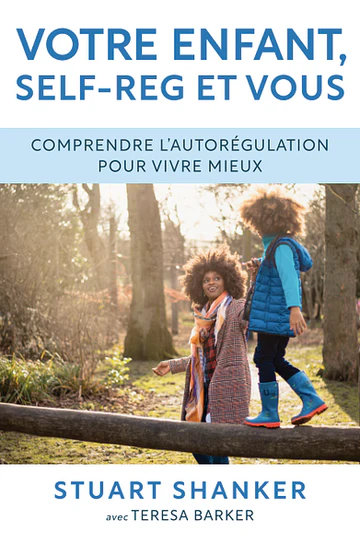
Votre enfant, Self-Reg et vous : comprendre l’autorégulation pour vivre mieux
Version papier – commander ici
Version numérique – accès instantané ici
Self-Reg est un livre pionnier qui présente une toute nouvelle compréhension des émotions et du comportement de votre enfant ; il offre aux parents un guide pratique pour aider leurs enfants à s’engager dans l’apprentissage et la vie avec calme et succès. Fondé sur les décennies de recherche et de travaux du Prof. Stuart Shanker avec des enfants et des parents, Self-Reg réoriente le pouvoir de la relation parent-enfant, pour un changement positif. L’autorégulation est la façon dont le système nerveux réagit au stress. Aujourd’hui, toute une génération d’enfants et d’adolescents est soumise à des niveaux de stress excessivement élevés et nous assistons à une explosion de problèmes émotionnels, sociaux, d’apprentissage, de comportement et de santé physique. Mais peu de parents reconnaissent les “facteurs de stress cachés” (physiologiques, sociaux et émotionnels) avec lesquels leurs enfants sont aux prises. Selon une conception de l’éducation très ancrée, les enfants manquent de maîtrise de soi ou de volonté, mais en réalité, c’est l’excès de stress qui est la véritable cause de ces problèmes.
Calm, Alert, and Learning
By Stuart Shanker | 2012
In recent years we have seen a revolution in educational thinking and practices. Scientific research in a number of fields is telling us that the key to student success is not so much intelligence but abilities like concentration, delay of gratification and emotional intelligence: abilities which are dependent on self-regulation. Self-regulation is the ability to manage the way our brains and bodies expend and restore the energy required to deal with the stresses (positive as well negative) involved in adapting to situations, facing challenges, learning and social relations.
But can a child’s ability to self-regulate be improved? Canada’s leading expert on self-regulation, Dr. Stuart Shanker, says it can and that educators have an important role to play in helping students develop this crucial set of abilities. Dr. Shanker, Distinguished Research Professor at York University and founder and CEO of The MEHRIT Centre, takes readers through an exploration of the five domains of self-regulation — biological, emotional, cognitive, social and prosocial. He explains what the domains are, how they work, what they look like in the classroom, and what we can do to help students strengthen in that domain.
Published in 2012, Calm Alert and Learning continues to be one of the top-selling educational publications in Canada. It has helped thousands of Canadian educators develop new ways to understand and address the challenges their students face.
“I’ve watched the explosive growth of The MEHRIT Centre and the remarkable response to Calm, Alert and Learning with a deep sense of what this is telling us about Canadian educators: how blessed we are as a nation to have attracted such passionate and endlessly curious individuals to become our children’s teachers.” Dr. Stuart Shanker
SHIPPING NOTICE: Apologies, we are not currently shipping to the USA due to the added cost the tariffs would force us to either absorb or pass on. Please reach out to your local booksellers or to publishers directly to purchase instead.
OTHER PUBLICATIONS

On Becoming a Self-Reg Haven
By Stuart Shanker & Susan Hopkins
Chapter 2 in Optimizing Learning Outcomes: Proven Brain-Centric, Trauma-Sensitive Practices

The First Idea: How Symbols, Language, and Intelligence Evolved from Our Primate Ancestors to Modern Humans
By Stanley Greenspan & Stuart Shanker
A limited number of signed (by Stuart Shanker) copies are available now! Purchase here.

Reframed: The Journal of Self-Reg
By Stuart Shanker, Susan Hopkins & Various Others