
The Five Domains are a holistic framework for understanding stress across five interconnected areas: biological, emotion, cognitive, social, and prosocial.
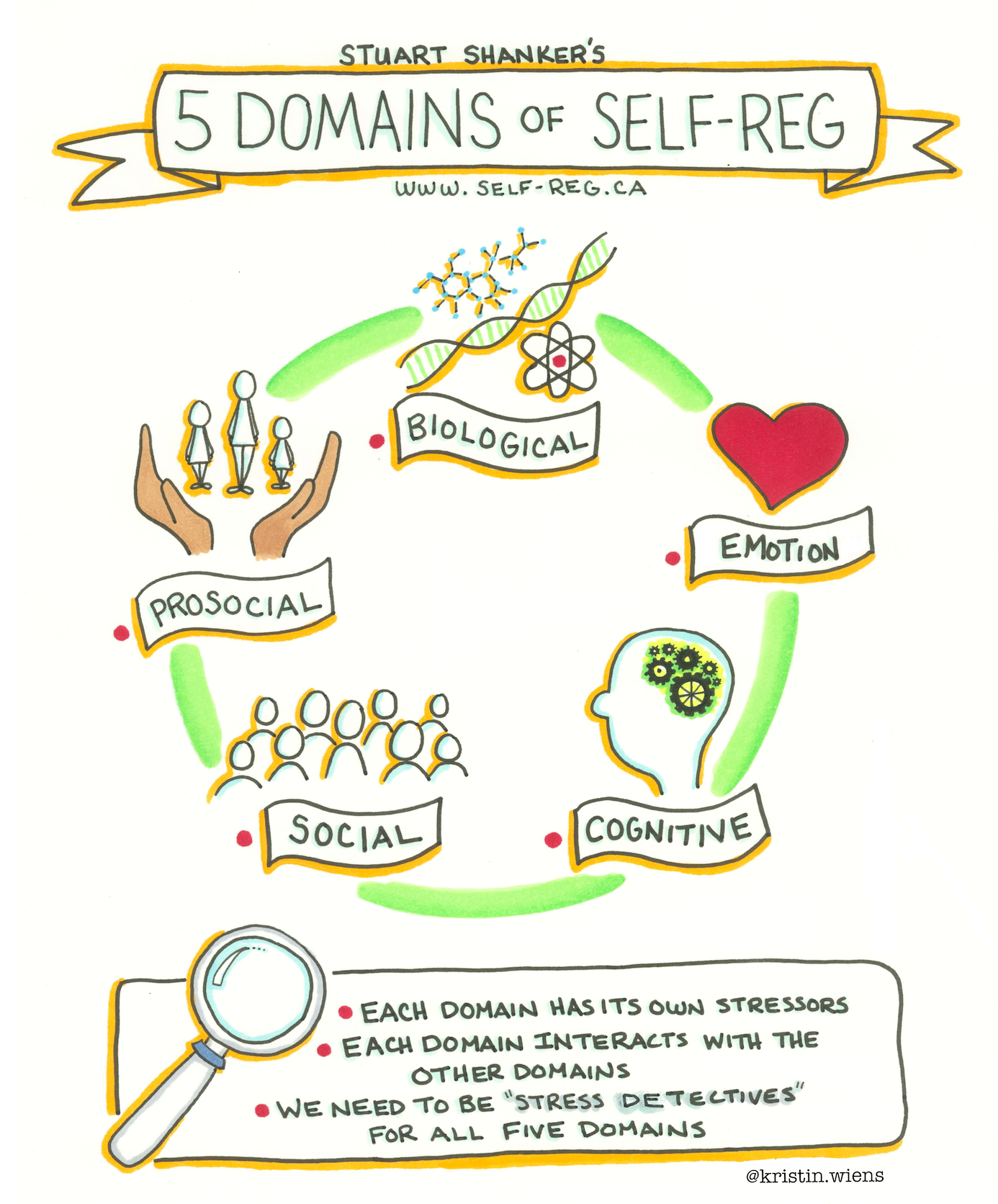
The Five Domains of Stress are a holistic framework for understanding the many kinds of stress affecting the brain-body system: biological, emotion, cognitive, social, and prosocial. Stressors can be positive or negative, obvious or hidden, and they rarely operate in isolation. Stress in one domain can increase stress in another, creating multiplier effects that change a person’s overall stress load and available energy. The Self-Reg shift is from looking for a single cause of behaviour to considering the whole person and the interaction among stresses. This gives us a richer way to understand why someone’s capacity can change from one moment or situation to another.
Stress rarely arrives one stressor at a time. A poor night’s sleep can make a difficult task harder, a noisy room more irritating, and a social misunderstanding much more upsetting. What looks like a problem in one domain may actually reflect stresses accumulating across several.
The Five Domains help us widen the lens. Instead of responding only to the most obvious behaviour, we can ask: What stresses are at play here? How might they be interacting? What is using energy?
That broader view often reveals possibilities for reducing stress that we would otherwise miss.
Stress is rarely one thing; understanding the whole pattern changes how we respond.
Hear Stuart explain what stress actually is and why understanding stress begins with energy.
Learn to recognize stress across the five interconnected domains and understand how stresses interact.
Build a deeper understanding of the science, framework, and practice of Shanker Self-Reg®.