

When I was in the classroom, I knew that I had to consider Self-Reg first. My teaching partner, Paula, and I spent so much time discussing stressors, calming options for students, and changes to our schedule and our environment that would better support student learning and Self-Reg. Now I’m in a system role as a Reading Specialist and curriculum is often at the forefront of my thoughts, but recently, I’ve thought more about how Self-Reg plays into my scheduling, my planning, and student learning.
Scheduling Decisions
Here are some of the schedule decisions that I make with Self-Reg in mind.
- A consistent schedule. I see the same groups of students every day at the same time. Educators and students can then anticipate when I will be there, and this reduces the stress of wondering and waiting.
- Adding food and drink options. We know that students find it difficult to learn if they’re hungry or thirsty. I always invite students to bring snacks or drinks with them. This seems to make the transition from the classroom to a new space — whether it be the library or a learning pod — a lot easier.
- Building in connecting time. Yes, I have a limited number of minutes with each of my groups, but I also know that it’s important for students to connect with each other and with me. I always start my group times with an opportunity for students to converse with each other. Often these times snacking and conversing also lead to unexpected learning opportunities … which I love!
I loved when a snack today prompted some unexpected reading. This was a good reminder to me that we need to support students in reading and applying skills taught in class in many different contexts.❤️❤️❤️ pic.twitter.com/Y5JUKpE7uY
— 𝘼𝙫𝙞𝙫𝙖 𝘿𝙪𝙣𝙨𝙞𝙜𝙚𝙧 (@avivaloca) March 5, 2024
Planning Decisions
Here are some of the ways in which Self-Reg impacts on my planning.
- Paying close attention to cognitive stressors. I often work with students who find reading and writing more challenging. I want to support them in taking risks, but I also know that if the work I provide is too difficult, the students are most likely going to exhibit behaviour and/or be reluctant to share. I think about Vygotsky’s Zone of Proximal Development, which I learned about in university, and I try to plan with this in mind.
- Being aware of social stressors. Since I work with many small groups, often students need to work with each other. This is exciting for many kids, but also challenging for some. Being more aware of my learners helps me think about different small group options, various material choices, and possibilities for small group and independent practice. The combination of both makes a big difference!
I realized why it’s so important to talk with kids as they do this. There was some confusion between sip and zip. What do these words mean? A good reminder that with reading, we are also always building comprehension.❤️ 2/2 pic.twitter.com/dov1ahRf91
— 𝘼𝙫𝙞𝙫𝙖 𝘿𝙪𝙣𝙨𝙞𝙜𝙚𝙧 (@avivaloca) February 26, 2024
- Regularly reflecting with classroom educators. While I try hard to build strong relationships with students, I only see kids for small amounts of time each day. I know that the classroom educators know these students best. Reflecting with them, allows us to reconsider groups, address challenges, and problem solve as a team.
Student Learning Decisions
Here are ways that I consider Self-Reg when it comes to student learning.
- Exploring a multi-sensory approach. Many of my young learners find sensory experiences calming. Connecting these experiences with reading is particularly valuable. (That said, I know that the same sensory options don’t work for every child, so I try to offer choice or consider the options that I provide knowing the students that I have at the time.)
We are following up on some in-class #ufli lessons with a closer look at letter formation. These kindergarten students asked if they could paint the letters. Thinking about our focus on student voice, this seemed like a good idea. Reviewing the sounds & names as we write them.❤️ pic.twitter.com/KDB9e9jPkH
— 𝘼𝙫𝙞𝙫𝙖 𝘿𝙪𝙣𝙨𝙞𝙜𝙚𝙧 (@avivaloca) February 9, 2024
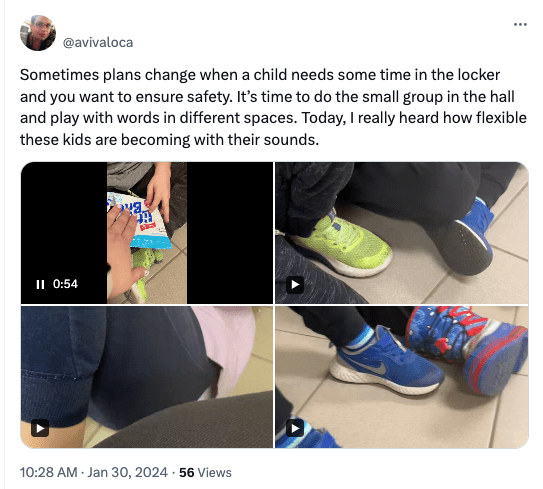
- Being flexible with spaces. I am happy to support reading and writing anywhere — from a hallway to a locker. If a child is finding a transition challenging, sometimes considering a new space makes a difference.
Today, this child found it hard to come inside. She went into her locker. What about Heggerty in the locker? She wasn’t sure about this, so we added checkmarks for each word. I wonder if the visual helped. Some days, you just have to embrace learning no matter where it happens.❤️ pic.twitter.com/McAsDyb40s
— 𝘼𝙫𝙞𝙫𝙖 𝘿𝙪𝙣𝙨𝙞𝙜𝙚𝙧 (@avivaloca) January 22, 2024
- Remembering that we teach kids first. This might seem obvious, and it’s something that I know and have reflected on before, but sometimes I need the reminder too. It’s easy to get hung up on the UFLI lesson number or the plan for the day, but some days are challenging for a variety of reasons, and if we can reduce stress for kids, then they will be ready to learn. Sometimes, maybe this is the best support that we can offer educators and kids!
What Are Your Self-Reg Considerations?
While this is not an exhaustive list, it definitely helps highlight some of my daily Self-Reg considerations. What are some of yours? I wonder if we think intentionally about Self-Reg, if we will also help reduce stress for students, colleagues, and ourselves.


