
By Kristina Schwartz, RECE a Self-Reg Learning Facilitator’s Program Alumni
One of the things I love most about Shanker Self-Reg® is that it doesn’t live neatly inside one profession or one role. Once you truly embody it, it quietly reshapes how you see people everywhere. Recently, I’ve had the privilege of bringing the Self-Reg lens into a volunteer space that matters deeply to me: Ontario’s Track 3 Adaptive Sports Association.
I am a sit-ski instructor volunteering at our local ski hill and, more recently, an interning Course Conductor. This internship model is an exciting growth initiative that Track 3 is piloting. It is a thoughtful, relational approach to capacity building. How very Self-Reg of them.
A Brief Word About Track 3
For those unfamiliar, Track 3 is a charitable adaptive ski and snowboard organization that supports children with a wide range of physical, cognitive, sensory, and developmental abilities. Its purpose is simple and profound: to make skiing safe, fun, and meaningful for everyone.
Track 3 is powered almost entirely by volunteers, and what struck me immediately when I first joined was just how extraordinary these humans are. Volunteers come from a wide range of life experiences. Although many do not come from child development, education, or medical backgrounds, they bring an openness to learning, a deep sense of care, and a genuine desire to support all athletes. Their hearts and minds are very much in the right place, grounded in a shared commitment to creating meaningful and positive experiences on the slopes.
And yet, good intentions don’t always come with a shared framework for understanding stress, behaviour, and regulation.
Noticing the Pull Toward Labels
As I became more involved in instructor training and Course Conductor shadowing, I began to notice how frequently labels were used as a descriptive crutch to talk about the athletes we might support.
These labels were never used maliciously. Often, they were offered as explanations or ways to prepare volunteers and set expectations. But what was frequently missing was context. Autism, for example, was sometimes spoken about as a broad umbrella term rather than as a vast and diverse spectrum of neurodivergence.
From a Self-Reg perspective, I felt that familiar internal nudge: something important is being flattened here.
Gently Shifting the Lens
In early January, while shadowing as a Course Conductor, I took the opportunity to gently, and at times unabashedly, push a Self-Reg agenda, supported by my Track 3 mentors. When possible, I encouraged us to loosen our reliance on labels and redirect our attention to the individual who would be in front of us on the hill.
Yes, diagnoses can matter. Sometimes they are essential for medical, safety, or equipment considerations. But they are not the whole story.
Rather than asking, “What does this diagnosis mean?” I invited volunteers to ask different questions:
- What might this skier be experiencing right now?
- What is their stress load today biologically, emotionally, socially, pro-socially, and cognitively?
- What is the environment asking of their nervous system in this moment?
Reframe the Behaviour
Instead of viewing a child who refuses to ski down the hill after getting off the chairlift as defiant or simply afraid, we explored the situation through a holistic Self-Reg lens. The noise. The cold. The height. The transition. The confinement and bulkiness of clothing and equipment. The cognitive demands. The emotional weight of expectation.
Suddenly, the behaviour made sense. The focus shifted from getting movement downhill to creating the conditions that would allow the athlete to move down the hill.

Co-Regulation on the Slopes
Self-Reg seamlessly translates to the ski hill. Volunteers are already co-regulating, often without realizing it. The Self-Reg framework simply gives language and intention to what skilled instructors intuitively do.
We talked about being a calm, steady presence when a child is overwhelmed, knowing when to down-regulate through predictability, stillness, reduced stressors, and reassurance, and when to up-regulate through play, movement, humour, or short games. We also discussed taking breaks before stress tips into shutdown (limbic breaking) or dysregulation, and defining success by engagement and joy rather than distance skied, which is already a core Track 3 value.
Behaviour as Communication
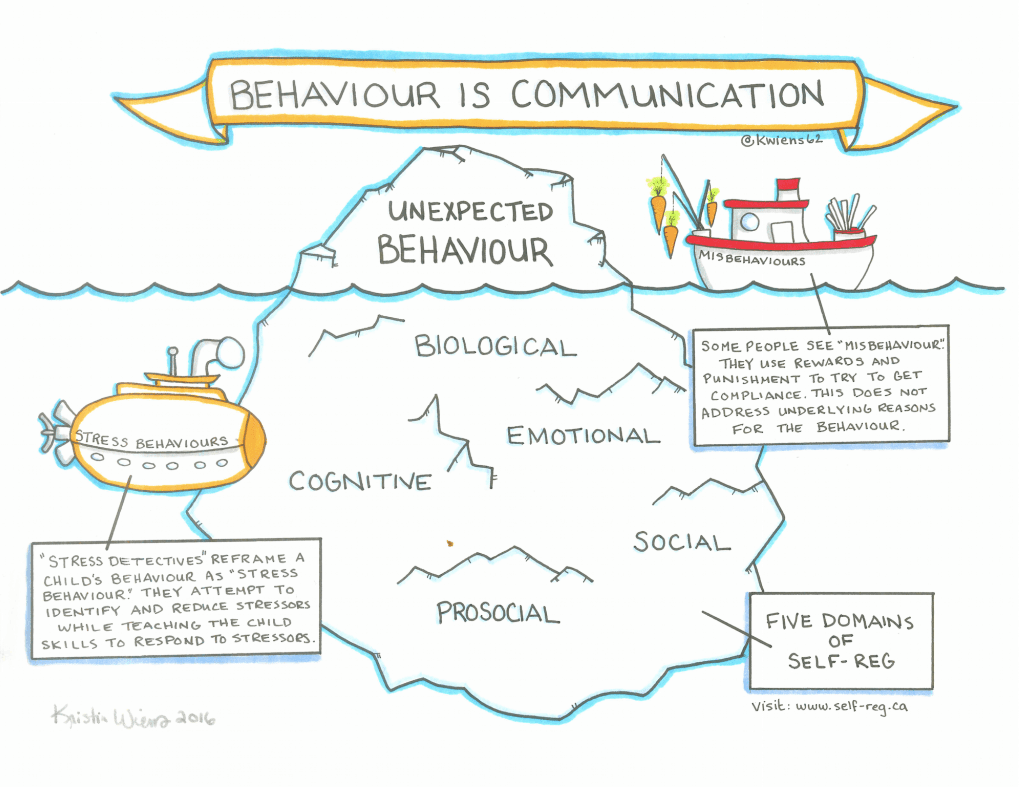
As volunteers began to see behaviour as communication, something shifted. Volunteers felt empowered to be co-learners and co-regulators on the slopes.
Why This Matters to Me
I often say that the true beauty of Self-Reg begins when we apply it to ourselves first. Whether I am supporting early years educators, mentoring leaders, or volunteering on the ski hill, the 5 Steps of Self-Reg can always be applied: reframe, recognize, reduce, reflect and restore. Watching volunteers gain confidence and shift their language reminds me why this work matters so profoundly. Shanker Self-Reg belongs everywhere humans are trying to connect, support, and grow together, especially on a snowy hillside, one chairlift at a time.


