Blog written by Elisabeth Han a Self-Reg Full Foundations Certificate Program and Self-Reg Learning Facilitator’s Program alumni
Bullying causes real harm.
Children who are bullied need safety, protection, and support. Harmful behaviour cannot simply be ignored or excused. Looking at bullying through a Self-Reg lens is not about “going easy” on children who hurt others. It is about asking harder questions about why the behaviour is happening in the first place, and what might actually help change it.
In Reframing Bullying (Shanker & Hopkins, Coming Fall 2026), Dr. Stuart Shanker asks us to consider whether some bullying behaviours may be stress-driven rather than simply intentional cruelty. As he writes:
“Such a question is not meant to somehow excuse or mitigate the seriousness of bullying. It is only an attempt to understand the aetiology so as to change the behaviour.”
Understanding Bullying Through a Self-Reg Lens
As educators and caregivers, we all share a deep commitment to supporting children’s well-being and creating safe, caring environments where they can grow and learn. Yet one challenge that continues to surface in schools and communities is bullying.
For many years, bullying has often been understood through a lens of self-control: stopping the behaviour, applying consequences, or teaching children to make better choices. While these approaches may sometimes stop the behaviour in the moment, they do not always help us understand why the behaviour is happening in the first place.
A Shift in Perspective
Through my learning in the Reframing Bullying course with Stuart Shanker and Susan Hopkins, I experienced an important shift in perspective. Instead of asking: “How do we stop this behaviour?” I began asking a different question: “What is driving this behaviour right now?”
Going Deeper Beneath the Behaviour
From a Self-Reg perspective, this does not mean saying, “They were stressed, so they could not help it.” Nor does it mean letting children off the hook.
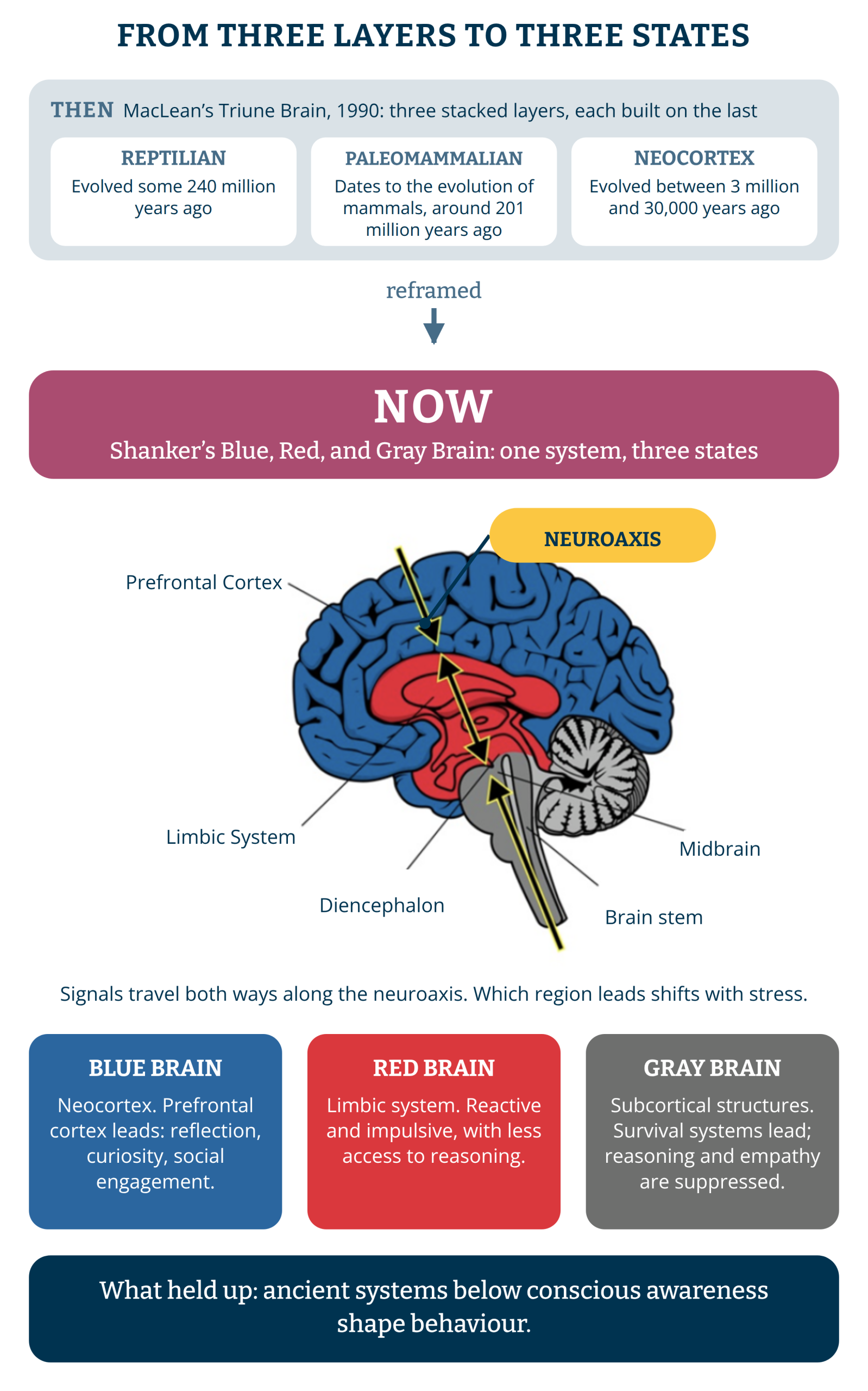
It means going deeper. It means asking what may be happening beneath the surface behaviour, in the deep brain systems connected to threat, fear, rage, seeking, belonging, status, and care and what has happened when a child can hurt another child and not seem to feel the distress we would expect them to feel.
In other words: Where did the empathy go?
What May Be Blocking Empathy?
This is the deeper question Self-Reg asks us to sit with.Not to excuse bullying. Not to minimize the harm. Not to remove accountability. Instead, it is about understanding what may be blocking empathy, what is driving the behaviour, and what conditions might help restore a child’s capacity to care.
From a Self-Reg perspective, bullying is not best understood as intentional cruelty or a simple lack of empathy. Rather, it can sometimes be understood as a stress-driven behaviour: a maladaptive and often self-harmful attempt by a child to regulate overwhelming stress. Dr. Shanker writes:
“Bullying is not a natural human impulse. It is the very opposite.”
Stress, Survival Mode, and Behaviour
When children experience high levels of stress, their nervous systems can shift into survival mode. In this state, the brain areas responsible for empathy, reflection, and learning are not fully accessible. This means that traditional responses such as punishment or lectures may not reach the child in the way we hope.
This does not remove responsibility.
Safety matters.
Repair matters.
Boundaries matter.
But understanding the roots of behaviour gives us another pathway forward.
Seeing Children Differently
When we move from asking: “What’s wrong with this child?” to asking: “What is this child experiencing?” we begin to see children differently. And when we see children differently, we respond differently.
This shift in perspective has profoundly influenced how I approach my role as an early childhood educator. By staying curious, lending calm, maintaining supportive boundaries, and responding with compassion, we create the conditions where children can restore balance, reconnect with others, and truly learn.
A Simple Truth
This approach reminds us of a simple truth: There is no such thing as a bad kid, only a child who needs support.